
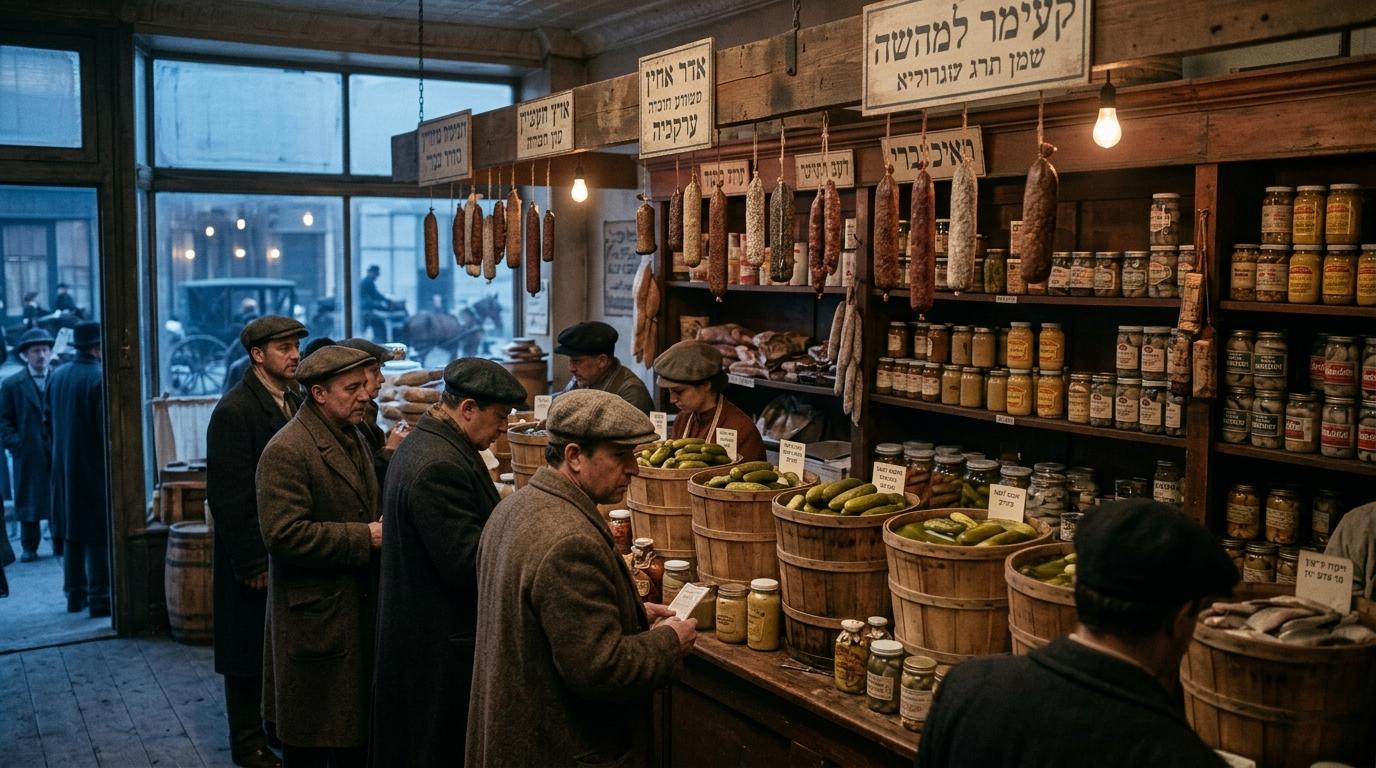
Pastrami on rye is one of the most culturally loaded sandwiches in American food history - a direct descendant of Eastern European Jewish immigration, Lower East Side street carts, and a preservation technique that's over 500 years old. It's not just lunch. It's a living artifact of how immigrant food traditions become American icons.
If you've ever wondered why a certain kind of deli feels like a pilgrimage rather than just a meal stop, the answer starts with the sandwich on the cutting board and goes back centuries. Here's the full story.
What Is a Jewish Deli, Really?
The term "Jewish deli" refers to a delicatessen rooted in Ashkenazi Jewish food traditions - specifically the cuisine of Jews from Eastern Europe, including Poland, Romania, Hungary, and Russia. These delis are defined by a specific set of items: cured and smoked meats, rye bread, pickles brined in salt and garlic, matzo ball soup, and a culture of generous portions and louder-than-average conversation.
The word "delicatessen" comes from the German delikatessen, meaning "delicacies," borrowed from the French délicatesse. German Jewish immigrants brought the concept to America in the mid-1800s. By the early 1900s, New York City's Lower East Side had over 1,500 kosher butcher shops and dozens of delis serving a Jewish immigrant population that had swelled to hundreds of thousands.
What separated the Jewish deli from a standard butcher or lunch counter was the culture around it. These were gathering places - loud, opinionated, communal - where the food carried memory and identity as much as flavor.
The Origins of Pastrami: Romania, Salt, and Survival
Pastrami's roots trace to Romania, where a preserved meat called pastramă was made from goose or pork. Romanian Jews adapted the technique using beef - specifically the navel cut, which is fattier and more flavorful - to stay within kosher dietary laws. The word itself likely derives from the Turkish pastırma, a dried cured meat with a lineage going back to the Ottoman Empire and, before that, to Central Asian preservation methods used by nomadic peoples who needed meat to last without refrigeration.
The process has three essential stages:
- Curing: The beef is rubbed with a mixture of salt, sugar, garlic, and spices - often including coriander and black pepper - and left to cure for several days, drawing out moisture and killing bacteria.
- Smoking: The cured meat is cold- or hot-smoked over hardwood, which adds flavor and further preserves the meat.
- Steaming: Before serving, pastrami is steamed until it becomes tender enough to slice thin. This is the step that separates great pastrami from mediocre pastrami - skip it and you get a tough, leathery slab instead of the silky, yielding slices that fall apart under gentle pressure.
Romanian Jewish immigrants brought this tradition to New York in the 1880s and 1890s. The oldest documented sale of pastrami in the United States is often attributed to Sussman Volk, a Romanian immigrant who opened a delicatessen on Delancey Street in Manhattan in 1887. Within a generation, pastrami had become synonymous with the New York deli experience.
Corned Beef: The Irish-Jewish Crossover
Corned beef has a more complicated origin story that illuminates just how much immigrant cultures influenced each other in America's cities. The "corns" in corned beef refer to large-grain rock salt used in the curing process - nothing to do with corn the vegetable.
Corned beef's association with Irish-American identity is actually a product of immigration economics, not Irish tradition. In Ireland, beef was expensive and largely exported to England. Most Irish people ate pork. When Irish immigrants arrived in New York and other American cities, they lived alongside Eastern European Jewish immigrants in the same neighborhoods - including the Lower East Side. Jewish butchers sold kosher-cured beef brisket at prices the working-class Irish could afford. Irish immigrants adopted it as a substitute for the bacon and pork they'd grown up with.
The result: corned beef became central to Irish-American culture through Jewish delis, not through anything that happened in Ireland. It's one of the most fascinating food cross-pollinations in American culinary history.
Rye Bread: The Third Pillar
The bread matters as much as the meat. Rye bread became the default vehicle for deli sandwiches because it was the bread Eastern European Jewish immigrants knew. Rye grain grows well in the cold climates of Poland, Russia, and the Baltic states, where wheat was harder to cultivate. Jewish bakers brought their rye bread traditions to America, and those loaves - dense, slightly sour, seeded with caraway - became inseparable from the deli identity.
The specific pairing of pastrami with rye is not arbitrary. The bread's earthy bitterness and chew cuts through the richness of the fat-marbled meat. Add a smear of deli mustard - sharp, vinegary, bright - and you have a flavor combination with genuine structural logic, not just tradition for tradition's sake.
American Deli Traditions: How Regional Variations Developed
As Jewish communities spread across the United States through the 20th century, deli culture traveled with them and adapted to local conditions. A useful comparison:
Region Deli Style Signature Characteristics New York City Classic Ashkenazi Jewish deli Steamed pastrami and corned beef, rye bread, half-sour pickles, egg cream, matzo ball soup Los Angeles California-influenced deli Lighter preparations, avocado additions, larger menus with non-traditional items Chicago Midwest deli Italian beef crossover influence, hearty portions, more casual format Philadelphia Urban neighborhood deli Strong connection to roast pork and Italian influences alongside Jewish deli staples; Reading Terminal Market as cultural anchor Montreal Canadian smoked meat tradition Smoked meat (similar to pastrami but spicier, less sweet), served on rye with yellow mustard at institutions like Schwartz's, established in 1928Philadelphia's deli identity deserves its own mention. The city's immigrant history - Jewish, Italian, Eastern European - created a food culture where the deli and the corner café blended more fluidly than in New York. Philadelphia catering companies and neighborhood delis today carry that layered heritage, often pairing traditional deli staples with the city's own culinary identity.
Why the Jewish Deli Declined - and Why It's Coming Back
At their peak in the mid-20th century, there were an estimated 1,500 Jewish delis in New York City alone. By 2010, that number had dropped below 20. Suburbanization, assimilation, changing dietary habits, and the high cost of running a quality deli all contributed to the decline.
But a genuine revival has been underway. A new generation of deli operators - some Jewish, many not - has been studying the craft seriously, sourcing quality beef, learning traditional curing and smoking techniques, and opening shops that respect the history while making the food accessible to a broader audience. The deli is no longer exclusively a product of one community. It belongs, in many ways, to American food culture as a whole.
That revival shows up in deli catering services in Philadelphia and across other major cities, where the demand for real pastrami, proper corned beef, and house-brined pickles has driven serious operators back to first principles - cure times, smoke woods, steam temperatures - the variables that determine whether a sandwich is good or transcendent.
What Makes a Great Deli Sandwich: The Non-Negotiables
- Meat quality: The navel cut for pastrami, brisket for corned beef - the fat content is not a flaw, it's the point.
- Cure time: Properly cured pastrami requires a minimum of 5 days in the brine. Shortcuts produce flat, overly salty results.
- Smoke: Hardwood smoking, not liquid smoke. The difference is immediately obvious in flavor depth.
- Steam time: The final steam should bring internal temperature to at least 200°F to break down collagen and produce the characteristic tender texture.
- Slice thickness: Thin-sliced, by hand if possible. The texture of hand-cut pastrami differs from machine-sliced because of how the fat layers separate.
- Bread freshness: Day-old rye ruins a great pastrami. The bread should have a firm crust and a moist, dense interior.
- Mustard: Spicy brown or deli-style yellow. Never mayonnaise on a traditional pastrami sandwich - it's not a matter of preference, it's a matter of structural integrity.
A sandwich built on those principles isn't just food. It's a direct connection to a 500-year chain of preservation knowledge, immigrant ingenuity, and American cultural assimilation. That's a lot to carry between two slices of rye - and it carries it beautifully.
History Of The Deli FAQ
What is the difference between pastrami and corned beef?
Both are salt-cured beef, but the processes diverge after curing. Corned beef is boiled or braised after curing. Pastrami is coated in a spice rub - typically heavy on coriander and black pepper - then smoked and steamed. The result is that corned beef is milder and more uniform in flavor, while pastrami has a smoky, spiced exterior and a richer, more complex taste. Both traditionally use the brisket, though pastrami is also commonly made from the navel cut.
Where did the Jewish deli originate?
The Jewish delicatessen as Americans know it developed on the Lower East Side of Manhattan in the late 19th and early 20th centuries, driven by the arrival of over two million Eastern European Jewish immigrants between 1880 and 1924. The format borrowed from German delicatessen culture and adapted Ashkenazi Jewish food traditions - cured meats, rye bread, pickles, and soups - to an American urban context.
Is pastrami always made from beef?
Traditionally in the Jewish deli context, yes - pastrami is beef, made from the navel or brisket cut, because kosher dietary law prohibits pork. The Romanian original, pastramă, was sometimes made with goose or lamb. Modern delis occasionally offer turkey pastrami as a leaner alternative, but traditional deli pastrami is always beef.
Why is rye bread used for deli sandwiches?
Rye bread was the everyday bread of Eastern European Jewish communities because rye grain thrives in the cold climates of Poland, Russia, and the Baltic states, where wheat was scarce. Jewish immigrant bakers brought that tradition to America, and rye became the standard deli bread. Practically, rye's density, slight sourness, and chew complement the fat and spice of cured meats far better than soft white bread, which collapses under the weight of a properly loaded sandwich.
What is Montreal smoked meat, and how does it differ from New York pastrami?
Montreal smoked meat is a close cousin of pastrami, with roots in the same Romanian Jewish immigrant tradition. The key differences: Montreal smoked meat uses a spice blend that is less sweet and heavier on black pepper and coriander than most New York pastrami preparations, and the meat is typically cured longer - up to 10 days. It is always served on rye with yellow mustard. Schwartz's Deli in Montreal, established in 1928, is the most famous institution associated with the style and remains a benchmark for the form.