Your corporate lunch caterer is no longer the right fit when you notice consistent food quality drops, repeated order errors, inflexible menus that ignore dietary needs, poor communication around changes, or pricing that no longer reflects the value delivered. Any one of these signals warrants a direct conversation. Two or more means it's time to start evaluating alternatives.
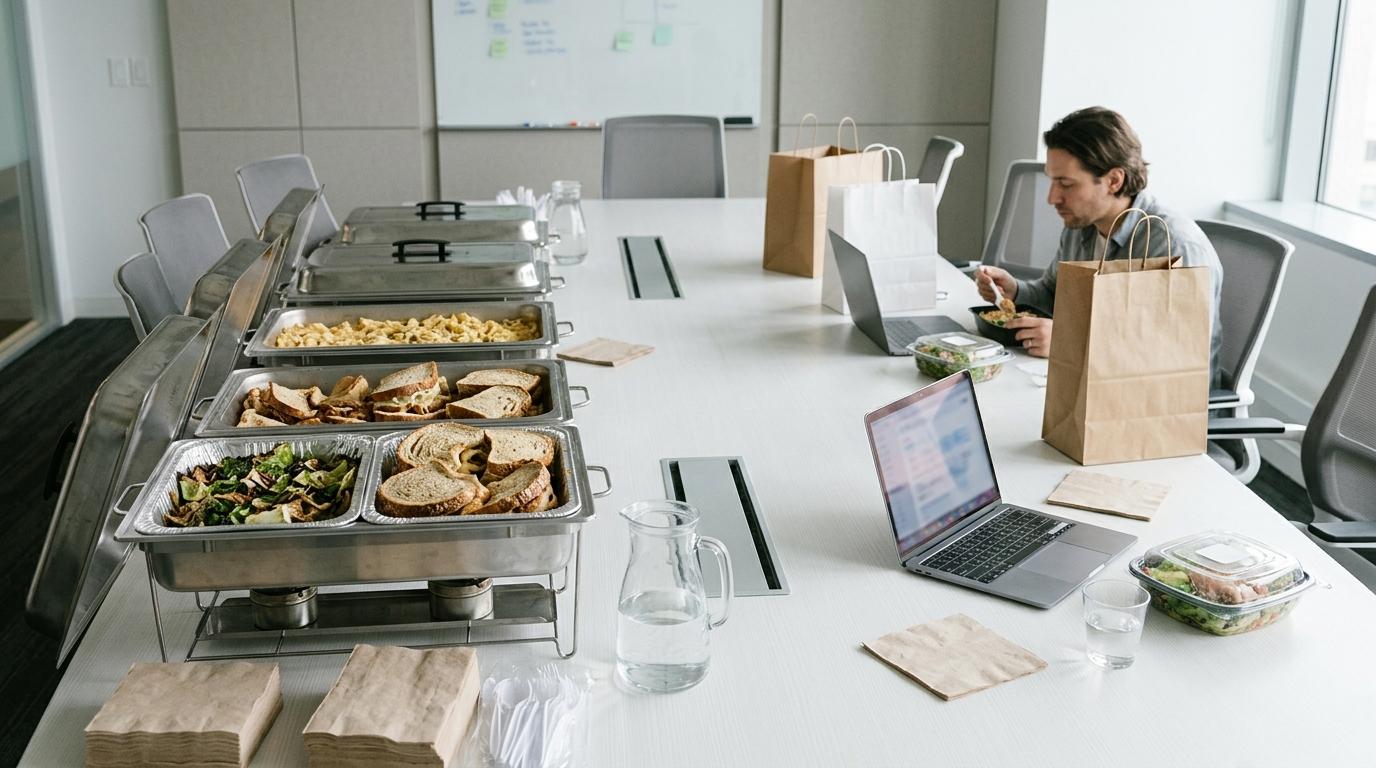
If your team has started eating at their desks with takeout bags instead of gathering around the catered spread, something has shifted. It might be the food. It might be the service. Either way, ignoring the signs costs more than just morale: it costs your company credibility as an employer that actually takes care of its people. Here's how to read the room and know when it's genuinely time to move on.
1. Food Quality Has Dropped and Nobody Is Addressing It
The most obvious sign is also the most common: the food just isn't as good as it used to be. What started as fresh-baked rolls and properly seasoned proteins has slowly become lukewarm sandwiches on stale bread. This kind of quality drift often happens gradually, which is exactly why so many companies tolerate it longer than they should.
Quality decline in catering typically has a few root causes. High-turnover kitchen staff means less consistency in preparation. A catering company scaling up its client roster without adding production capacity will start cutting corners. Supply chain pressures lead to ingredient substitutions that never get disclosed. The practical result is a lunch that looks fine on paper but leaves your team disappointed every Tuesday and Thursday.
The real test isn't one bad delivery. It's what happens after you bring it up. A reliable Philadelphia catering company will ask specific follow-up questions, adjust the affected items, and confirm with you that the correction held on the next order. If your feedback is met with vague apologies that don't translate into visible change within two or three orders, you are dealing with a structural problem, not a one-time lapse.
Document the pattern. Keep a simple log of which items were unsatisfactory and when you reported them. That record protects you when it comes time to review your contract or negotiate terms with a replacement caterer.
2. Dietary and Dietary Restriction Needs Are Being Ignored
Philadelphia's workforce is genuinely diverse, and Center City office buildings house teams with a wide range of dietary needs: gluten-free, halal, vegan, low-sodium, tree-nut allergies. A catering partner that treats these as inconvenient edge cases is not built for business catering in 2026.
The problem shows up in two ways. The first is outright failure: you requested a nut-free option and it arrived with a shared serving utensil from the walnut salad. That's a health and liability issue, not a preference issue. The second is subtler: the "vegan" option is always the same uninspired pasta primavera, while omnivores rotate through four proteins and three grain options. That signals the caterer is checking a box rather than building a real menu.
Good deli catering services in Philadelphia will maintain documented allergen protocols, allow you to submit standing dietary flags tied to specific recurring orders, and rotate the accommodation options so that employees with restrictions aren't eating the exact same thing every week. If your current provider can't tell you their allergen handling process in writing, that's a significant gap.
Ask your caterer directly: how do you prevent cross-contamination between allergen items during packaging? If the answer is uncertain or inconsistent, escalate or start looking elsewhere. The cost of a workplace allergic reaction far exceeds the cost of switching vendors.
3. Communication Breaks Down Every Time Something Changes
Businesses change constantly. Headcount shifts. Meetings run long. Budget cycles require a reduced order for one month. A catering partner built for corporate accounts knows this and builds flexibility into its process. One that isn't a good fit will treat every deviation from the standard order as a disruption.
Watch for these specific communication failures:
- You submit a change 48 hours in advance and it still doesn't get processed correctly
- There's no single point of contact, so every call starts from scratch
- Invoicing doesn't match what was delivered, and reconciling it takes more than 10 minutes
- Last-minute substitutions happen without notice, so you're surprised at delivery instead of informed in advance
- Confirming a modified order requires you to follow up more than once
For businesses catering in Center City Philadelphia, where office schedules are tight and lunch windows are often 45 minutes or less, communication failures aren't minor inconveniences. A 20-minute delay because the driver couldn't find parking and nobody called ahead derails an entire working lunch.
A well-run philly catering business will assign you an account contact, respond to order changes within a defined window (typically 24 hours), and proactively notify you of any substitution before delivery rather than after. If you're the one doing all the chasing, the relationship is already unbalanced.
4. The Menu Has Become Stale and Rigid
Breakfast catering and lunch catering work best when there's enough rotation to keep employees genuinely interested. When the same six sandwiches show up every week in a slightly different order, participation drops. When participation drops, the perceived value of the benefit drops with it, and leadership starts questioning the line item.
Menu rigidity is a growth problem. Many smaller catering operations build a core menu and defend it because expanding requires sourcing, testing, and training. That's a legitimate operational challenge, but it becomes your problem when you're paying for a perk that employees have stopped looking forward to.
A strong catering partner for Philadelphia businesses will offer seasonal rotations, at minimum quarterly, and be willing to incorporate feedback into future planning. They'll also be transparent about what's genuinely available versus what's a seasonal limitation. If you've asked for a Mediterranean rotation, a grain bowl option, or a hot breakfast alternative and gotten a soft "we'll look into that" for six months, the answer is no and they're not telling you directly.
Compare what your current caterer offers against what's available in the Philadelphia market:
| Feature | Strong Corporate Caterer | Underperforming Caterer |
|---|---|---|
| Menu rotation | Quarterly or more frequent updates | Same core menu for 6+ months |
| Dietary accommodations | Documented protocols, rotating options | One static "vegan" or "GF" item |
| Communication | Named account contact, 24-hour change window | General inbox, inconsistent response times |
| Order accuracy | Errors addressed within next delivery | Errors acknowledged but repeated |
| Pricing transparency | Itemized invoices, advance notice of changes | Lump-sum invoices, surprise price increases |
| Flexibility | Accommodates headcount changes, paused weeks | Minimum order commitments with no flex |
5. The Pricing No Longer Reflects the Value
Price increases are a reality in the food service industry, and any honest assessment of catering for businesses in 2026 has to acknowledge that ingredient and labor costs have moved significantly over the past several years. What matters isn't whether prices increase; it's whether the value delivered justifies the new price point.
The problem looks like this: your per-person cost has gone up 15–20% over two contract cycles, but the portion sizes are smaller, the protein quality has downgraded, and the packaging is less professional than it used to be. You're paying more for less, and your caterer isn't having that conversation with you proactively.
Before concluding a price increase is unjustified, request an itemized breakdown. Legitimate cost drivers include protein price increases, packaging materials, and fuel surcharges. These are real. But if the increase is uniform across all items with no explanation, or if you're being billed for items that weren't delivered, those are billing integrity issues that go beyond cost-of-goods adjustments.
Getting two or three quotes from other Philadelphia catering companies is not a betrayal of your vendor relationship. It's responsible procurement. You may find your current caterer is competitively priced and simply needs a direct conversation about value. Or you may discover that comparable service is available at a meaningfully lower cost per person, with better menu variety and more responsive account management.
What to Do When You've Spotted Multiple Signs
Start with a documented conversation. Send your account contact a written summary of the specific issues: dates, items, and outcomes. Give the caterer a defined response window, typically 5–7 business days, and be clear about what resolution looks like. If you receive a substantive response and a concrete improvement plan, evaluate whether the plan actually gets implemented over the following three to four orders.
If the issues persist or the response is dismissive, begin your evaluation of alternative catering services in Philadelphia in parallel. Switching caterers is operationally straightforward if you plan it correctly: run a trial order from a new vendor for a smaller meeting before you transition the full account. That gives you real data without disrupting your team's regular lunch program.
Your catering relationship should make your workday easier, not harder. When it starts generating more administrative friction than it saves, the math has already shifted.
Corporate Lunch Catering in Philadelphia FAQ
How much notice should a Philadelphia corporate caterer require for order changes?
Most established business caterers in Philadelphia require 24–48 hours notice for standard order modifications. Changes to headcount or dietary flags submitted within that window should still be accommodated for standing weekly orders. If your caterer requires 72+ hours for routine changes, that's a sign of limited operational flexibility.
What's a reasonable per-person budget for corporate lunch catering in Center City Philadelphia?
Per-person costs for business lunch catering in Center City Philadelphia vary based on format, but deli-style and café catering orders for office groups generally run in a range that reflects current food service labor and ingredient costs. Request itemized proposals from at least three vendors and compare cost-per-item rather than total invoice to get an accurate comparison.
How do I handle switching caterers mid-contract?
Review your current contract for termination notice requirements, typically 30 days, and any minimum commitment clauses. Give written notice within that window, document the reasons for termination in case of a billing dispute, and time the transition so your team doesn't experience a gap in service. Running a trial order from the new caterer before the transition date is strongly recommended.
Should my caterer provide allergen information in writing?
Yes. Any catering company serving corporate accounts should be able to provide written documentation of allergen protocols and flag which menu items contain the top common allergens: tree nuts, peanuts, shellfish, gluten, dairy, and eggs. Verbal assurances are not sufficient for workplace food programs where liability is a real concern.
What's the difference between a deli catering service and a full-service corporate caterer in Philadelphia?
Deli catering services in Philadelphia typically specialize in cold and room-temperature items: sandwiches, wraps, salads, and breakfast spreads. Full-service corporate caterers may offer hot entrees, staffed service, and event catering in addition to recurring office lunch programs. For daily or weekly business catering, a high-quality deli catering operation often delivers better consistency and value than a full-service company whose primary focus is event work.