How Philadelphia Office Managers Can Handle Dietary Restrictions in Corporate Catering
The single most effective approach to catering for dietary restrictions in a Philadelphia office setting is building a confirmed dietary roster before you place any order, then working with a caterer who structures menus around labeled, separated components rather than custom one-off substitutions. That two-step process eliminates most last-minute scrambles and keeps every guest fed without slowing down the event.
If you manage a Center City office, you already know how fast a working lunch or catering for a business meeting can go sideways when someone at the table can't eat anything on the tray. This guide walks through exactly how to avoid that, from collecting dietary data to reading a corporate catering menu intelligently to knowing which questions to ask your Philadelphia catering company before the order is finalized.
Step One: Collect Dietary Data Before You Order
Dietary restrictions fall into a few distinct categories, and conflating them creates real problems. A food allergy (peanuts, tree nuts, shellfish, dairy, gluten) is a medical issue where cross-contamination can send someone to the emergency room. A food intolerance (lactose, FODMAPs) causes discomfort but is not typically life-threatening. A dietary preference (vegan, vegetarian, halal, kosher, low-carb) is a personal or religious choice that still deserves full respect at a catered event.
The practical move is to send a simple pre-event form to attendees at least 72 hours before your office lunch delivery or meeting. Ask three specific questions: Do you have any food allergies? Do you have any food intolerances? Do you follow any specific dietary pattern? Separate fields, not a single open text box, because "no red meat and I'm allergic to tree nuts" reads very differently than two clearly flagged line items on a catering order.
Once responses are in, tally them into four buckets: severe allergens requiring separated preparation, intolerances that need ingredient-level attention, religious or ethical dietary patterns, and standard omnivore. Share that tally with your caterer, not the individual names, to protect employee privacy while giving the kitchen exactly what it needs to plan.
Reading a Corporate Catering Menu for Dietary Compatibility
A well-structured corporate catering menu flags allergens on every item, not just the ones that seem obvious. When you are reviewing a menu from any Philadelphia catering company, look for these specific markers before you commit to an order.
- Allergen labeling at the item level: Every sandwich, salad, and side should list the top nine allergens (milk, eggs, fish, shellfish, tree nuts, peanuts, wheat, soybeans, sesame) as they apply to that specific item.
- Cross-contact disclosures: A reputable caterer discloses whether items are prepared in a shared kitchen where cross-contact with major allergens is possible. This is non-negotiable for guests with severe allergies.
- Protein flexibility on platters: Event sandwich platters that allow you to specify the protein count by type (turkey, roast beef, veggie, tuna) give you granular control without requiring entirely separate orders for each dietary group.
- Clearly vegan or vegetarian-coded items: Not just items that happen to lack meat, but items explicitly tested and labeled as such, including dressings and condiments.
- Gluten-free or gluten-aware options: There is a meaningful difference between a kitchen that offers a gluten-free bread swap and one that packages gluten-free items in sealed containers to prevent cross-contact. Ask which applies.
If a menu does not include this level of detail, call the caterer directly before ordering. A philly catering business that handles regular corporate accounts will have allergen sheets available on request. If they don't, that tells you something important about how they operate.
Structuring the Order: Platters vs. Individually Packaged Meals
This is the trade-off most office managers face when planning office lunch delivery for mixed dietary groups.
| Format | Best For | Dietary Control Level | Cost Efficiency | Setup Complexity |
|---|---|---|---|---|
| Shared platters (event sandwich platters, salad bowls) | Groups of 15+ with mostly standard diets | Moderate: allergen-free items can be mixed by guests | High: lowest per-head cost | Low: one setup, self-serve |
| Hybrid model (platters + labeled individual boxes for restrictions) | Mixed groups with 2–5 specific allergen needs | High: restricted guests get sealed, labeled meals | Moderate: small upcharge for individual boxes | Moderate: two setups, clear signage needed |
| Fully individual packaged meals | Small meetings (under 12) or high-complexity dietary mix | Highest: total separation, each meal labeled by name | Lower: higher per-head cost | Higher: requires accurate headcount and name list |
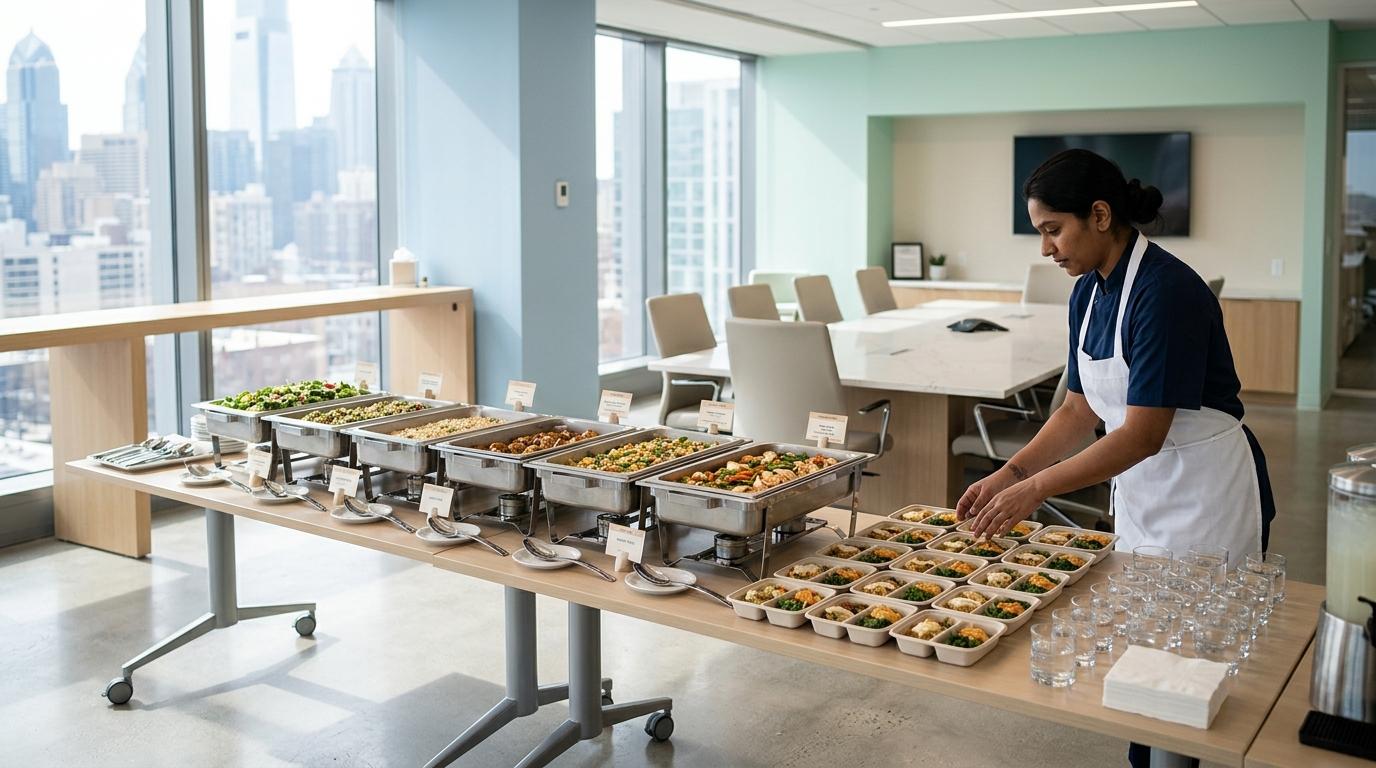
For most Center City Philadelphia office lunches, the hybrid model delivers the best balance. The main group eats from platters, which keeps costs reasonable and presentation clean. The two guests with celiac disease and the one guest who keeps halal each receive a clearly labeled, sealed box prepared with appropriate care. No one is singled out, and the caterer has a clear production path for every item on the order.
Breakfast Catering and Dietary Restrictions: A Specific Scenario
Breakfast catering for business meetings carries its own dietary complexity. Standard breakfast spreads center on wheat (pastries, bagels), dairy (cream cheese, butter, yogurt), and eggs. That combination excludes guests who are vegan, gluten-intolerant, dairy-free, or following a low-carb plan all at once.
A practical breakfast catering order for a mixed office group should include at least three protein sources that are not egg-dependent, a clearly labeled dairy-free spread option alongside standard cream cheese, at least one gluten-free grain option (certified gluten-free oats, for example, or grain-free granola), and fresh whole fruit as a universal fallback that works for nearly every dietary pattern.
When you are ordering breakfast catering from a Philadelphia catering company, confirm that the gluten-free pastries or breads are packaged separately and not transported on the same tray as wheat-based items. Cross-contact during delivery is a common source of problems that gets overlooked when the order looks correct on paper.
On-Site Logistics: Labeling, Layout, and Communication
Even a perfectly composed order falls apart if the setup at your office is confusing. When your office lunch delivery arrives, take five minutes to organize the table before guests enter the room. Place tented labels in front of every item. Labels should list the item name, the protein or main ingredient, and any relevant allergen flags. A label that reads "Roast Beef on Sourdough (Contains: Wheat, Dairy)" takes 15 seconds to make with a printed sheet from your caterer and removes all ambiguity.
Allergen-safe or special-diet items should sit at one end of the table with consistent visual cues (a different colored plate, a small flag) so guests who need them can identify them immediately without having to ask in front of the group. This small step reduces awkwardness and speeds up the serving process during time-pressured business meetings.
Brief your meeting host or office coordinator before guests arrive so they can answer basic questions without consulting you. Knowing that "the green-labeled box on the far left is gluten-free and dairy-free" is the kind of information that takes 30 seconds to pass on and saves real disruption mid-meeting.
Choosing the Right Philadelphia Catering Company for Dietary-Complex Orders
Not every philly catering business has the systems in place to manage multi-restriction orders reliably. When you are vetting deli catering services in Philadelphia for your office, ask these specific questions before placing an order.
- Do you provide allergen information for every item on your corporate catering menu, including sauces and dressings?
- How do you prevent cross-contact in your kitchen for orders that include severe allergens?
- Can you package allergen-specific meals individually and label them by restriction or guest name?
- What is your cutoff time for dietary modification requests after an order is placed?
- Do you have documented experience with halal, kosher, or religious dietary accommodations?
A caterer who answers these questions confidently and specifically, without hesitation or deflection, is one whose kitchen has actually worked through these scenarios before. Vague answers ("we can usually accommodate most things") are a signal to probe further or look elsewhere for your catering for business meeting needs.
Philadelphia Office Catering and Dietary Restrictions FAQ
How far in advance should I submit dietary restriction information to a Philadelphia caterer?
Submit your dietary roster at least 48 hours before the event, with 72 hours preferred for orders involving severe allergens or religious dietary requirements like halal or kosher. Same-day requests for allergen accommodations are high-risk and most reputable caterers in Philadelphia cannot guarantee safe preparation on that timeline.
Are event sandwich platters a good option for groups with multiple dietary restrictions?
Platters work well for groups where restrictions are primarily preference-based (vegetarian, low-carb). For guests with true food allergies, supplement the shared platters with individually packaged, labeled meals prepared with allergen separation. This hybrid approach keeps per-head costs manageable while protecting guests with medical dietary needs.
What is the difference between gluten-free and gluten-aware catering?
Gluten-free refers to items formulated without gluten-containing ingredients. Gluten-aware means the kitchen takes steps to reduce cross-contact but cannot certify complete separation because gluten-containing items are prepared in the same space. For guests with celiac disease, gluten-aware is not sufficient. Always confirm which standard your Philadelphia catering company actually meets.
Can deli catering services in Philadelphia handle halal or kosher orders?
Many Philadelphia deli catering services can accommodate halal orders with adequate notice, because halal-certified proteins are increasingly available through local suppliers. Certified kosher catering is more logistically complex and typically requires working with a caterer who holds an active kosher certification or who sources from a certified kosher kitchen. Ask for documentation, not just verbal assurance.
How should I handle last-minute dietary restriction changes for a business meeting?
Contact your caterer immediately when you learn of a change, even if the cutoff window has technically passed. Explain the restriction clearly and ask what is feasible rather than assuming nothing can be done. Most established Philadelphia catering companies can swap a packaged item or set aside an unlabeled allergen-free option if notified before the order leaves the kitchen. After the event, update your office dietary roster so future orders start with accurate data.