Professional catering for a 20-person team lunch typically costs 15–30% less per head than ordering restaurant takeout for the same group, once you account for delivery fees, per-item markups, and the hidden time cost of coordinating individual orders. Here is how those numbers break down and what it means for Philadelphia businesses making this decision regularly.
Why Takeout Feels Cheaper But Often Isn't
The sticker price on a restaurant menu is rarely what your company actually pays when you order takeout for a team. By the time you add a delivery fee, a service fee, a tip, and the per-item markup that third-party platforms build into catering-adjacent orders, a $12 sandwich can easily land at $18–$22 landed cost per person. Do that for 20 people and you are at $360–$440 before you have even thought about plates, napkins, or someone spending 45 minutes collecting everyone's dietary preferences over Slack.
The coordination cost is real money too. If an office manager or executive assistant spends 90 minutes per week organizing individual takeout orders across four weekly team meals, that is roughly six hours of labor per month. At a fully loaded cost of $30–$40 per hour for that role, you are spending $180–$240 monthly in staff time that never shows up on a food invoice.
Professional catering consolidates that work. One call or online form, one invoice, one pickup or delivery window. The operational overhead collapses, and the per-person food cost drops because catering is priced for volume from the start.
The Actual Per-Person Math: Takeout vs. Catering
To make this concrete, here is a realistic comparison for a 20-person working lunch in Center City Philadelphia using current 2026 market pricing.
| Cost Component | Restaurant Takeout (per person) | Professional Catering (per person) |
|---|---|---|
| Base food cost | $14–$18 | $12–$16 |
| Platform/delivery fee | $2–$4 | $0–$1 (often included) |
| Service fee / tip | $3–$5 | $1–$2 (gratuity optional) |
| Supplies (plates, utensils) | $1–$2 (often missing) | Included |
| Staff coordination time | $4–$6 (allocated) | $0.50–$1 |
| Total estimated cost | $24–$35 | $13.50–$20 |
The gap widens with group size. At 50 people, catering providers in Philadelphia can often bring the base food cost to $10–$14 per person, while takeout orders at that scale get progressively more chaotic and expensive as multiple restaurants, multiple deliveries, and multiple receipts pile up.
What Professional Catering Actually Includes That Takeout Doesn't
When you work with a dedicated Philadelphia catering company, you are buying a package, not a collection of items. That distinction matters operationally.
A professional caterer typically delivers with:
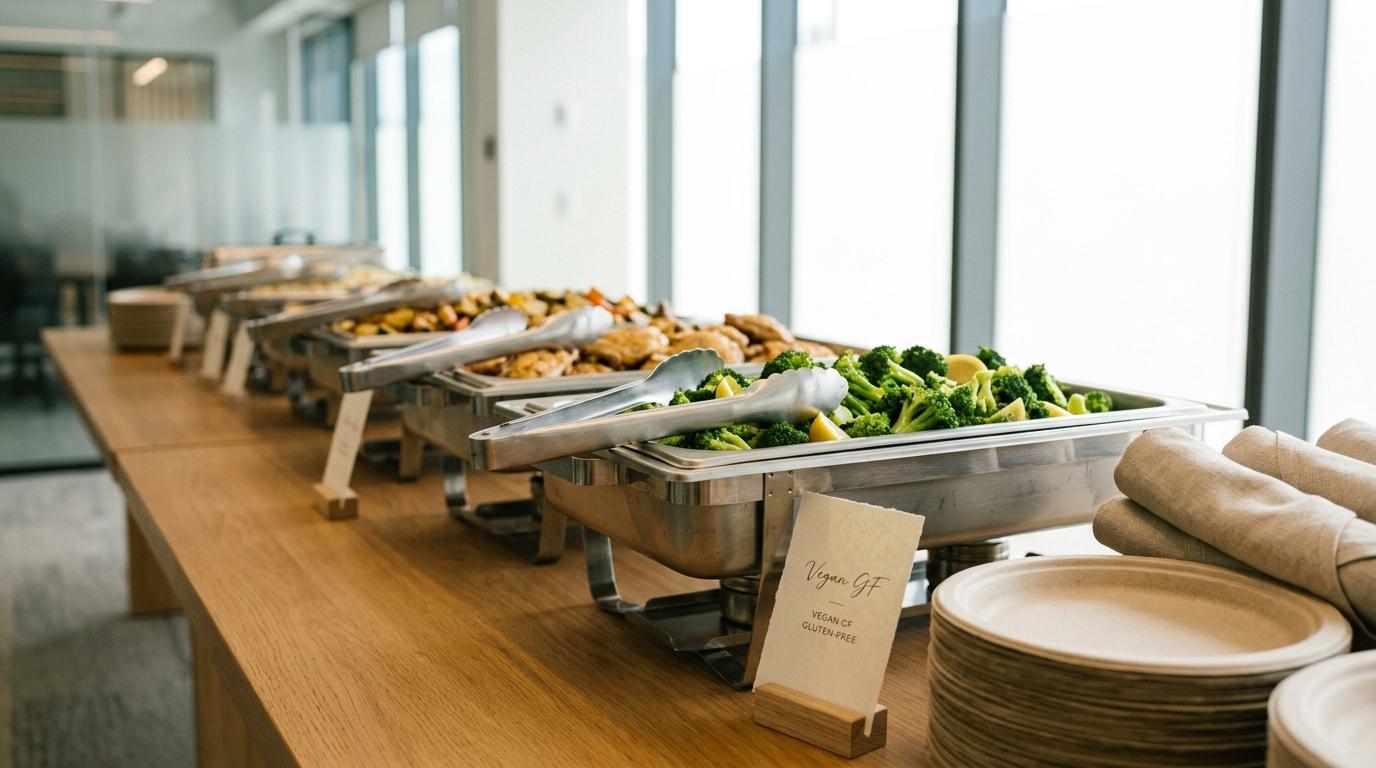
- Chafing dishes or insulated containers that keep food at safe serving temperature
- Serving utensils, tongs, and labels for each dish
- Plates, napkins, and cutlery
- A delivery and setup window coordinated to your meeting schedule
- One point of contact for changes or dietary accommodations
Restaurant takeout gives you food in bags. If your team needs to eat in a conference room at 12:15 sharp before a 1:00 p.m. client call, that distinction is enormous. Catering arrives ready to serve. Takeout arrives and then requires 10–15 minutes of unpacking, hunting for missing condiments, and figuring out who got the wrong order.
Breakfast Catering: The Category Where the Gap Is Biggest
If your company does regular morning meetings, breakfast catering in Philadelphia is the single category where professional catering most dramatically outperforms takeout on a per-person basis.
Individual breakfast orders from a coffee shop or fast-casual spot tend to run $10–$15 per person before fees, and breakfast items travel especially poorly. Eggs get rubbery, pastries lose texture, and hot drinks arrive lukewarm. A breakfast catering spread, by contrast, can be structured around items that hold well: fresh fruit, bagels and spreads, yogurt parfait stations, pastry assortments, and a coffee service setup. At volume, that kind of spread comes in at $8–$13 per person fully serviced, often with a better perceived quality than cold scrambled eggs in a container.
For businesses in Center City Philadelphia with regular 8:00 or 9:00 a.m. leadership meetings, committing to a weekly breakfast catering account with a local provider is almost always cheaper, better-looking, and less stressful than ordering individually from three different apps.
Deli Catering vs. Full-Service Catering: Choosing the Right Tier
Not every business meal needs full-service catering with chafing dishes and setup. Deli catering services in Philadelphia occupy a useful middle tier between takeout and formal event catering.
Deli-style catering typically means:
- Sandwich and wrap platters built for groups, not individual orders
- Salad trays, fruit platters, and chip-and-dip accompaniments
- Packaging designed for communal serving rather than individual bags
- Pricing that reflects bulk preparation without a full event catering surcharge
For a working lunch of 10–30 people that does not require elaborate setup, deli catering hits the sweet spot. You get the per-person cost savings and the logistical simplicity of professional catering, without paying for services you do not need. Compare this to takeout at the same scale, and you are typically saving $6–$10 per person while eliminating coordination friction entirely.
When Takeout Still Makes Sense
Catering is not always the right answer. If you are feeding two or three people, the economics favor individual orders. Most Philadelphia catering providers set practical minimums of 8–12 people, and for groups below that, the volume discount does not apply. There is also a spontaneity factor: catering generally requires 24–48 hours of lead time, while takeout can be ordered and delivered in 45 minutes. For unplanned working sessions or impromptu team hangs, takeout wins on flexibility.
The decision rule is straightforward. If your group is 10 or more, the meeting is planned at least a day in advance, and the professional presentation of the meal matters at all (client meetings, town halls, onboarding lunches), professional catering is the financially and logistically better option almost without exception.
How to Evaluate a Philadelphia Catering Company Before You Commit
Before you set up a catering account with any Philadelphia business catering provider, get clear answers to these questions:
- What is your minimum order size? Some providers require 15–20 people; others work with groups of 8.
- What is included in the per-person price? Confirm whether supplies, delivery, and setup are bundled or billed separately.
- How far in advance do you need an order? Standard is 24–48 hours, but some providers accommodate same-day for recurring accounts.
- Can you accommodate dietary restrictions across a menu? A good caterer can flag which items are gluten-free, vegetarian, or nut-free without requiring a separate order process.
- Do you offer recurring account pricing? If you are ordering weekly, most Philadelphia catering companies will negotiate a standing account rate that reduces per-order cost further.
Recurring accounts are worth asking about specifically. A business that orders lunch three times a week for 25 people is a meaningful account for any local caterer, and that leverage is yours to use during the initial conversation.
Philadelphia Business Catering FAQ
How much does catering cost per person in Philadelphia for a standard business lunch?
For a standard working lunch with sandwiches, salads, and drinks, most Philadelphia catering companies price in the $13–$20 per person range fully inclusive in 2026. Breakfast catering runs slightly lower at $8–$13 per person. Full-service hot lunch catering with setup and staffing can reach $22–$35 per person depending on the menu.
What is the minimum group size for professional catering in Philadelphia?
Most Philadelphia catering providers set minimums between 8 and 20 people. Deli-style catering operations often work with groups as small as 8–10. Full-service event caterers typically require 20 or more. For groups under 10, individual takeout or a restaurant reservation is usually more practical.
How much notice does a Philadelphia catering company need?
Standard lead time for business catering in Philadelphia is 24–48 hours. For large events or complex menus, 3–5 business days is more realistic. Some providers offer same-day service for established recurring accounts, but that is the exception rather than the rule for first-time orders.
Is catering or takeout better for a client-facing business lunch?
Catering is the clear choice for any client-facing meal. Professional catering arrives presentation-ready with proper serving equipment, consistent temperatures, and no missing items. Takeout for a group lunch in front of a client requires unpacking bags and improvising, which undercuts the professional impression you are trying to make.
Can a Philadelphia catering company handle weekly recurring orders for an office?
Yes, and most will offer preferred pricing for recurring accounts. Setting up a standing weekly or twice-weekly catering order with a local provider is one of the most efficient ways Philadelphia businesses reduce both food cost and administrative overhead. Ask specifically about recurring account rates, standing menus, and flexible cancellation windows when you set up the account.