Ordering breakfast catering for your Philadelphia office comes down to four decisions: how much lead time you give the caterer, what food format fits your meeting setup, how you handle dietary restrictions upfront, and whether you want recurring service or one-off ordering. Get those four right and the morning runs itself.
Why Morning Catering Is Different from Lunch or Dinner Orders
Breakfast catering has a tighter operational window than any other meal. Deliveries for a 9 a.m. staff meeting in Center City need to land between 8:15 and 8:45. That 30-minute window means a caterer stuck in traffic on the Schuylkill or circling for a loading dock on Market Street can blow up your entire setup before the coffee is even poured.
That compression also changes what food formats make sense. Hot items like scrambled eggs or breakfast sandwiches lose quality fast if they sit for 20 minutes before anyone touches them. Bagel and pastry spreads, by contrast, hold well for 45–60 minutes at room temperature, which makes them the default choice for most Philadelphia business catering orders. If your meeting starts late or runs long on the front end, a cold spread gives you far more flexibility than a hot one.
The other difference is timing on your end. Lunch and dinner menus are stable by mid-morning the day before. Breakfast quantities depend heavily on who actually shows up, and office attendance in 2026 is still variable for hybrid teams. Order for confirmed headcount, not projected headcount, and add 10–15% buffer rather than padding the full number.
Lead Times Every Philadelphia Office Manager Should Know
Most catering companies serving Center City Philadelphia and the surrounding business districts operate on these minimum lead times for corporate breakfast orders:
- Same-day orders: Available from select deli and cafe caterers in Philly, but menu options are limited to pre-packaged or easy-assemble formats. Expect a premium of 15–25% over standard pricing.
- 24-hour notice: The minimum for a standard bagel and coffee catering order, a pastry tray, or a fruit and yogurt spread. Most Philadelphia deli catering services can fulfill this reliably Monday through Friday.
- 48–72 hours: Required for anything involving hot food, custom dietary accommodations, or orders above 30 people. This window also gives your caterer time to source specific items if your team has strict dietary needs.
- One week or more: Necessary for recurring weekly setups, large all-hands breakfasts over 75 people, or events with branded packaging or display requirements.
If you manage office operations for a business in Center City, scheduling recurring breakfast catering on a standing weekly order almost always costs less per person than placing individual one-off orders. Many Philadelphia business catering companies offer standing-order discounts in the range of 8–12% for clients who commit to a weekly or biweekly cadence.
Choosing the Right Food Format for Your Meeting Type
The format of your catering order should match how your meeting actually runs, not just what sounds appealing on a menu. Here is a practical breakdown:
| Meeting Type | Best Format | Why It Works | Watch Out For |
|---|---|---|---|
| Seated staff meeting (under 20 people) | Boxed individual breakfasts | No shared serving, easy cleanup, clear per-head cost | Higher per-person cost than platters |
| Standing reception or open office setup | Bagel trays, pastry platters, fruit spreads | Holds well for 45–60 min, people graze naturally | Hard to track quantities consumed |
| Client-facing early meeting | Upscale pastry assortment + premium coffee service | Signals quality without being heavy or formal | Cost per person is higher; confirm client dietary needs in advance |
| All-hands or company-wide breakfast | Buffet-style hot and cold spread | Accommodates volume and variety | Requires 72-hour notice and setup space planning |
| Recurring Monday morning team huddle | Standing bagel and coffee catering order | Predictable cost, minimal reordering friction | Menu fatigue if the same spread repeats every week |
For most recurring morning meeting catering in Philly, the bagel and coffee format wins on three criteria: cost, reliability, and guest satisfaction. A well-sourced bagel spread from a Philadelphia deli catering company with fresh cream cheese varieties and a strong coffee setup will consistently outperform a mediocre hot buffet at a higher price.
Handling Dietary Restrictions Without Making It Complicated
Dietary needs at office breakfast events in 2026 are not edge cases. Expect that in any group of 15 or more Philadelphia office workers, you will have at least one person who is gluten-free, one who is vegan or vegetarian, and one with a tree nut allergy. Plan for it by default, not as an afterthought.
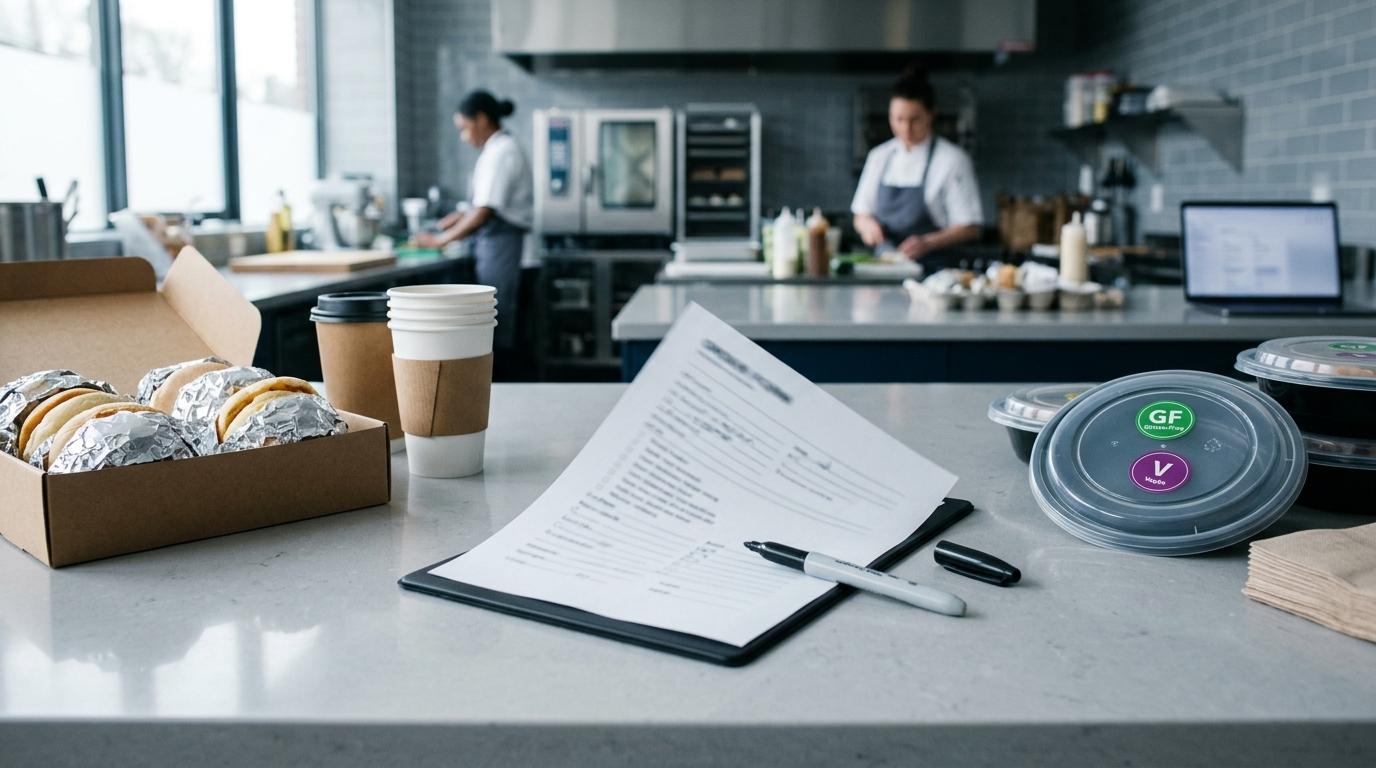
The simplest system: when you send the meeting invite, include a one-line note asking team members to flag dietary restrictions by a specific date. Give that information to your caterer at the time of ordering. Reputable Philadelphia catering companies will label items clearly and can provide separated portions for allergen concerns.
For gluten-free guests, request a dedicated GF bagel option or a packaged alternative kept separate from the main tray. Cross-contact from a shared serving board is a real issue for guests with celiac disease, and a good caterer will handle this proactively if you flag it upfront.
Vegan requests at breakfast are easy to fulfill: fruit platters, oatmeal cups, avocado toast options, and dairy-free cream cheese are all standard offerings from most cafe catering operations in Philly. The issue is usually not availability, it is communication. Ask your caterer explicitly, and confirm the substitution is on the final order confirmation.
Logistics That Actually Matter for Center City Deliveries
Center City Philadelphia office buildings each have their own delivery protocols, and ignoring them is the most common reason breakfast catering arrives late or ends up stuck in a lobby. Before placing your first order with any corporate breakfast catering company in Philadelphia, answer these questions:
- Does your building have a designated loading dock, or can vendors use the main entrance?
- Is there a freight elevator, and does it require advance scheduling?
- Does your building security need the caterer's name and vehicle information in advance?
- What floor are you on, and is there a service entrance that is faster than the main lobby?
Pass this information to your caterer when you place the order. Write it into the order notes every time, not just on the first order. Staff turnover at catering companies is real, and assuming the delivery driver knows your building setup from a previous visit is a reliable way to create a problem on a high-stakes morning.
For offices in the 30th Street Station corridor, University City, or Old City, delivery timing challenges differ from those in the core Market Street and Broad Street buildings. Confirm that your caterer serves your specific neighborhood, not just "Philadelphia," before you lock in a recurring arrangement.
What to Ask Before You Commit to a Catering Company
Not every company offering breakfast delivery in Center City Philly is set up for consistent corporate service. Before you place a recurring order with any Philadelphia catering business, ask these five questions directly:
- What is your on-time delivery rate for morning orders? A reputable company will answer with a specific number or a policy, not a vague reassurance.
- Do you have a dedicated corporate account manager, or do I reorder through a general line every time? A dedicated contact point eliminates a significant amount of friction on recurring orders.
- How do you handle a short-notice cancellation? Meetings get rescheduled. Know the cancellation window and the fee structure before it matters.
- Can you accommodate dietary restrictions at the item level, or only at the tray level? Item-level accommodation is better for mixed groups.
- Do you provide setup and breakdown, or drop-off only? For larger breakfasts or client-facing events, setup service is worth the cost. For a weekly staff meeting, drop-off is usually sufficient.
Office Breakfast Catering Philadelphia FAQ
How far in advance should I order breakfast catering for an office meeting in Philadelphia?
For a standard bagel and coffee catering order or pastry spread, 24 hours is the working minimum with most Philadelphia catering companies. For hot food, large groups over 30 people, or custom dietary accommodations, 48–72 hours is the practical standard. Recurring weekly orders should be set up at least one week in advance.
What is the average cost of corporate breakfast catering per person in Philadelphia?
In 2026, a standard bagel and coffee catering spread for a Philadelphia office runs roughly $15–$22 per person depending on the caterer and inclusions. Boxed individual breakfast packages typically run $18–$28 per person. Client-facing or premium setups with upscale pastries and specialty coffee service can reach $30–$45 per person. Same-day orders add a 15–25% premium.
Can I set up a recurring weekly breakfast catering order for my Philly office?
Yes. Most Philadelphia business catering companies that serve corporate accounts offer standing weekly or biweekly arrangements. These typically come with a discount of 8–12% compared to one-off order pricing and reduce the administrative work of reordering each week. Confirm the cancellation policy for individual weeks before committing to a standing arrangement.
What food options work best for a morning client meeting in Center City?
For a client-facing breakfast in a Center City Philadelphia conference room, a premium pastry assortment paired with quality coffee service is the strongest choice. It is not heavy, it holds well during conversation, and it reads as intentional without being formal. Add a fruit tray and one or two savory options like mini breakfast sandwiches if the meeting runs past 90 minutes.
How do I make sure breakfast catering arrives on time to my Philadelphia office building?
Provide your caterer with the building's delivery protocol in writing every time you place an order: loading dock location, security badge or check-in requirements, freight elevator scheduling, and the contact number for someone on-site that morning. For buildings with strict delivery windows, confirm the caterer has a 30-minute buffer built into the scheduled arrival. Request a delivery confirmation text or call when the order leaves the kitchen.