Catering delivery in Center City Philadelphia works best when you book a delivery window 45–60 minutes before the meal, confirm loading dock or freight elevator access with building management at least 3 business days ahead, and give the caterer a named on-site contact with a cell phone. Narrow streets, strict building rules, and heavy foot traffic make logistics the difference between a hot, on-time lunch and a cold, late one.
This guide walks through the real obstacles planners face getting food into offices and venues between Market Street, Walnut Street, Broad Street, and the Delaware River, and how to solve each one.
Why Center City Delivery Is Different
Center City is a dense grid. Many of the streets are one-way, some are only 20 feet wide, and loading zones are short and shared with rideshares, buses, and construction. A van that would park easily in a suburban office park may circle the block three times here.
Three factors cause most delays:
- Parking and curb access: Commercial loading zones often limit stops to 15–30 minutes, and double parking risks a ticket.
- Building security: Many high-rises require a visitor check-in, ID, and a certificate of insurance (COI) for vendors.
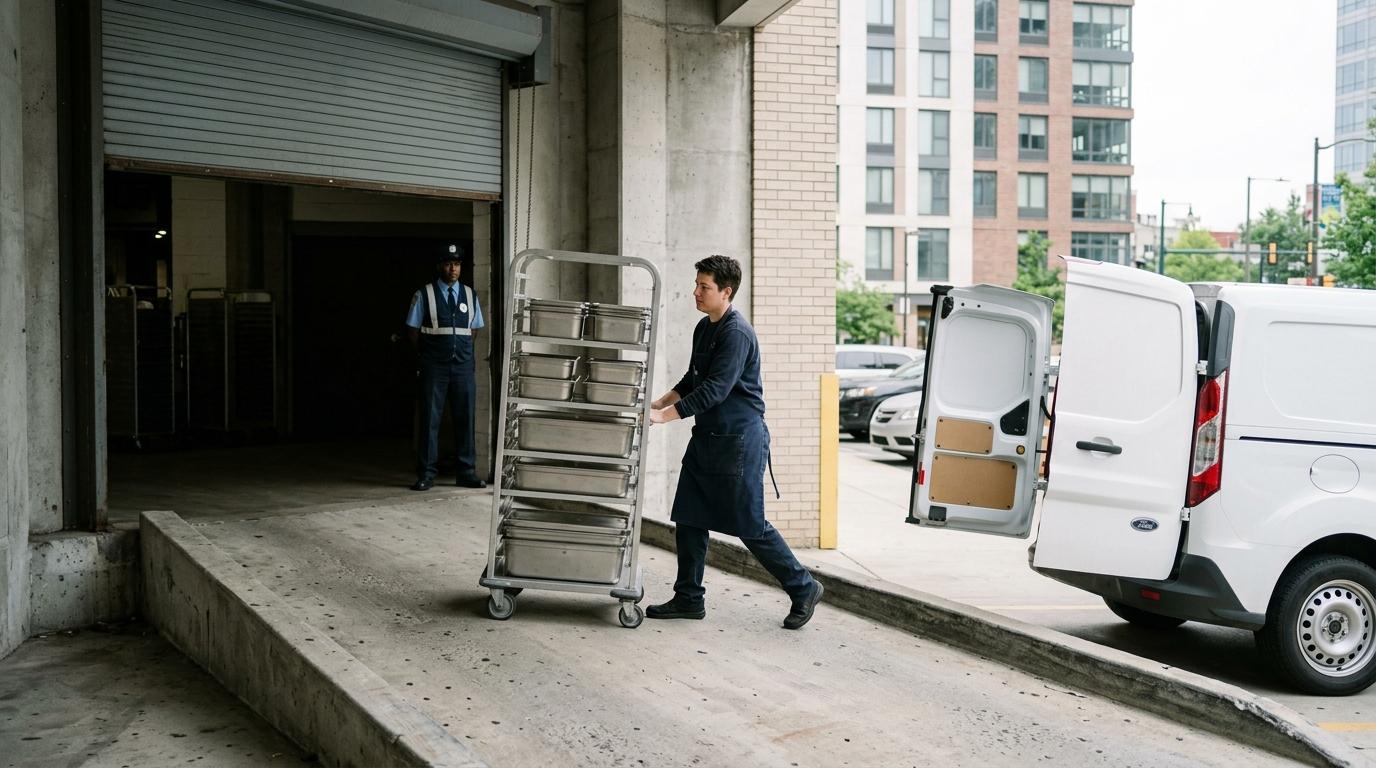
- Vertical transport: Food carts often must use the freight elevator, which may be shared with moves, deliveries, or maintenance.
If you are ordering from a local cafe or deli, ask whether they deliver with their own staff or use a third-party courier. Staff delivery usually means better handling and setup. Courier delivery can be cheaper but typically ends at the lobby.
Catering for an Office Building: What to Confirm Before You Order
Catering for an office building starts with a call to property management, not the caterer. Ask these questions about 3–5 business days out:
- Is a COI required? Many Class A buildings want a certificate listing the property owner as additional insured. Your caterer needs time to request it from their insurer.
- Where do vendors enter? Some buildings route deliveries through a dock on a side street, not the main lobby.
- What are the freight elevator hours? Many restrict vendor use during morning and lunch rush, commonly 11:30 a.m. to 1:30 p.m.
- Is there a reservation system? Some buildings require you to book the elevator in a tenant portal.
- Can food be left in the lobby? If the answer is yes, your team must be ready to carry it up immediately.
Give the caterer the exact suite number, floor, and entrance, plus the name and mobile number of someone who can meet the driver. A vague "ask for Sarah at the front desk" is how a 12:00 lunch becomes a 12:40 lunch.
Choosing the Right Delivery Style
Not every order needs the same service level. Match the style to the meeting, the headcount, and the building.
| Delivery Style | Best For | What You Handle |
|---|---|---|
| Drop-off, packaged | Breakfast meetings, boxed lunches, groups under 25 | Setting out food, trash, serving utensils if not included |
| Drop-off with setup | Team lunches of 25–75, client meetings | Heat sources if buffet items are not self-contained, cleanup |
| Full-service with staff | Receptions, events over 75, executive presentations | Space access, elevator coordination, staffing hours |
| Individually labeled boxes | Mixed dietary needs, hybrid teams, training days | Distribution by name list |
For recurring needs, such as weekly breakfast catering or a standing deli order for a Friday team lunch, set a fixed delivery window and a fixed contact. Repeat orders run smoothest when the driver already knows the dock, the elevator, and the suite.
Coordinating Philadelphia Event Venue Catering
Philadelphia event venue catering has a different rulebook than an office. Many venues, including museums, historic buildings, hotels, and rooftop spaces, either require you to use an approved caterer list or charge an outside-vendor fee. Ask this first, before you fall in love with a menu.
Key questions for any venue:
- Is outside catering allowed? If so, is there a fee, a required insurance minimum, or a mandatory venue-supplied staff member?
- What are the load-in and load-out windows? Historic and shared spaces often give only 60–90 minutes for each.
- What kitchen access exists? A venue with only a prep room means the caterer must bring food fully cooked and use warming equipment. Ask about power: how many outlets and what amperage.
- Are there stairs or no elevator? Upper-floor event spaces in older buildings may require hand-carrying, which affects staffing and cost.
- What are the noise and timing rules? Some venues restrict deliveries during neighboring events.
Ask the caterer to visit the venue or review photos of the loading path. A 5-minute walkthrough reveals a surprising number of problems, such as a narrow door that will not fit a rolling hot box.
Timing, Weather, and Food Safety
Hot food should stay at or above 135°F and cold food at or below 41°F, which are the standard food safety thresholds. In a city delivery, the main risks are traffic and elevator waits, not distance.
- Build in a buffer: Schedule arrival 45–60 minutes before serving. For high-rises with security screening, make it 60 minutes.
- Avoid peak traffic: Roads around Broad Street, Market Street, and the bridge approaches slow down between 7:30–9:30 a.m. and 4:30–6:30 p.m.
- Plan for weather: Rain and snow slow curbside unloading. Ask the caterer how they protect food in transit, and whether they have covered carts.
- Use insulated carriers: Ask whether food travels in insulated hot boxes and chilled coolers, particularly for deli platters and salads.
Event days such as parades, marathons, concerts, and street closures can change routes entirely. Check the city's street closure notices the week of your event and tell your caterer the exact entrance you want them to use.
A Practical Delivery Checklist
Send this to your caterer and your building contact 48–72 hours ahead:
- Full address, entrance, floor, and suite or room name
- On-site contact name and cell number
- Delivery window and the time food will be served
- Headcount and dietary breakdown (vegetarian, vegan, gluten-free, nut allergy)
- Loading dock or freight elevator instructions
- COI status and building requirements
- Parking or curb instructions
- Where food will be placed and who will clear it afterward
Also decide what happens after the meal. Ask whether the caterer picks up equipment, such as chafing dishes and trays, or whether disposable, compostable packaging is used. Pickup requires a second building visit and sometimes a second elevator reservation.
Cost Factors to Expect
Delivery fees in Center City vary by caterer, order size, and service level. Ask for an itemized quote that separates food, delivery, setup, staffing, equipment, and any venue or building fees. Common add-ons include:
- Delivery or service fees, often a flat rate or a percentage of the order
- Staff hours for setup and breakdown, with minimum shifts
- Equipment rental for chafers, linens, and serving utensils
- Parking or loading fees if a garage or paid zone is required
- Rush fees for orders placed with less than 24–48 hours of notice
Ordering earlier is the simplest way to save money. Most local caterers prefer 48–72 hours for standard orders and 1–2 weeks for events over 50 people.
Center City Catering Delivery FAQ
How far in advance should I order catering for a Center City office?
Order at least 48–72 hours ahead for groups under 50, and 1–2 weeks ahead for larger events. If your building requires a certificate of insurance or an elevator reservation, start 3–5 business days out.
Do caterers need a certificate of insurance to deliver to a high-rise?
Many Class A office buildings in Center City require one, listing the property owner or manager as additional insured. Ask your property manager and pass the exact wording to your caterer.
How early should catering arrive before a meeting?
Plan for arrival 45–60 minutes before serving time. Use the longer end for buildings with security check-in, shared freight elevators, or upper floors.
Can I use any caterer at a Philadelphia event venue?
Not always. Many venues require an approved caterer list or charge an outside-vendor fee. Confirm the policy, insurance minimums, and kitchen access before signing a contract.
What is the best catering option for a small team meeting downtown?
Individually labeled boxed meals or a drop-off breakfast or deli spread work best for groups under 25. They require little setup, move quickly through security, and handle mixed dietary needs cleanly.