Corporate catering in Philadelphia PA comes down to one decision made before any food is ordered: matching the format of the meal to the stakes of the meeting. A daily team lunch needs speed and consistency. A client presentation needs presentation-quality food and zero logistical surprises. Getting that match wrong is more expensive than the catering bill itself.
This guide covers the specific mechanics of catering a business lunch in Center City Philadelphia, from daily office programs to one-off client meetings, so you can order with confidence rather than hope.
Know Your Meeting Type Before You Pick a Caterer
Center City businesses generally fall into three catering scenarios, and each one has different requirements.
Working lunches and team meetings prioritize turnaround and value. Food needs to arrive on time, require minimal cleanup, and feed a group of 10–50 people without anyone managing it like an event. Individual boxed meals or well-organized platters work better here than buffet setups that eat into meeting time.
Client-facing lunches and presentations are reputation moments. The food becomes part of the impression your firm makes. You want professional delivery, labeled dietary options, and packaging that looks intentional rather than thrown together. A catering company that runs café-style operations in Philly often handles this better than a generic delivery service because presentation is baked into what they do daily.
Company-wide events and all-hands lunches involve logistics at a different scale: coordinating for 75–300+ people, managing dietary variety across a large group, and timing delivery so food stays fresh when people actually eat. This is where you need a caterer with documented experience in office building delivery, not just restaurant takeout.
Before you contact a single catering company, write down which scenario fits, how many people you're feeding, and whether you need setup and breakdown included or just drop-off.
What Makes Center City Catering Logistics Different
Catering for businesses in Center City Philadelphia is not the same as suburban office park catering. The physical environment creates specific challenges that affect every order.
Building access is the first friction point. Most Center City high-rises require caterers to use service elevators, sign in with security, and coordinate with building management. A caterer unfamiliar with this process will be late, and late food at a noon meeting is a problem that starts at 12:05.
Parking and loading dock availability varies significantly by block. Buildings along Market Street, JFK Boulevard, and the Avenue of the Arts all have different policies. Experienced Philadelphia business caterers know these buildings and plan accordingly. When you're evaluating caterers, ask directly: "Have you delivered to our building before, and what is your arrival buffer for Center City deliveries?"
Space inside the office is also a real constraint. Many Center City suites don't have a dedicated catering room. A good caterer will ask about your setup space during ordering and recommend formats that work with what you have, whether that's a conference table, a small kitchen counter, or a hallway credenza.
Menu Choices That Actually Work for Business Lunches
The most common mistake in office catering is over-ordering complexity. Here is a realistic comparison of common formats against actual business lunch needs.
| Format | Best For | Dietary Accommodation | Setup Time | Mess Level |
|---|---|---|---|---|
| Individual boxed meals | Working meetings, 10–40 people | Easy to label per person | Under 10 minutes | Low |
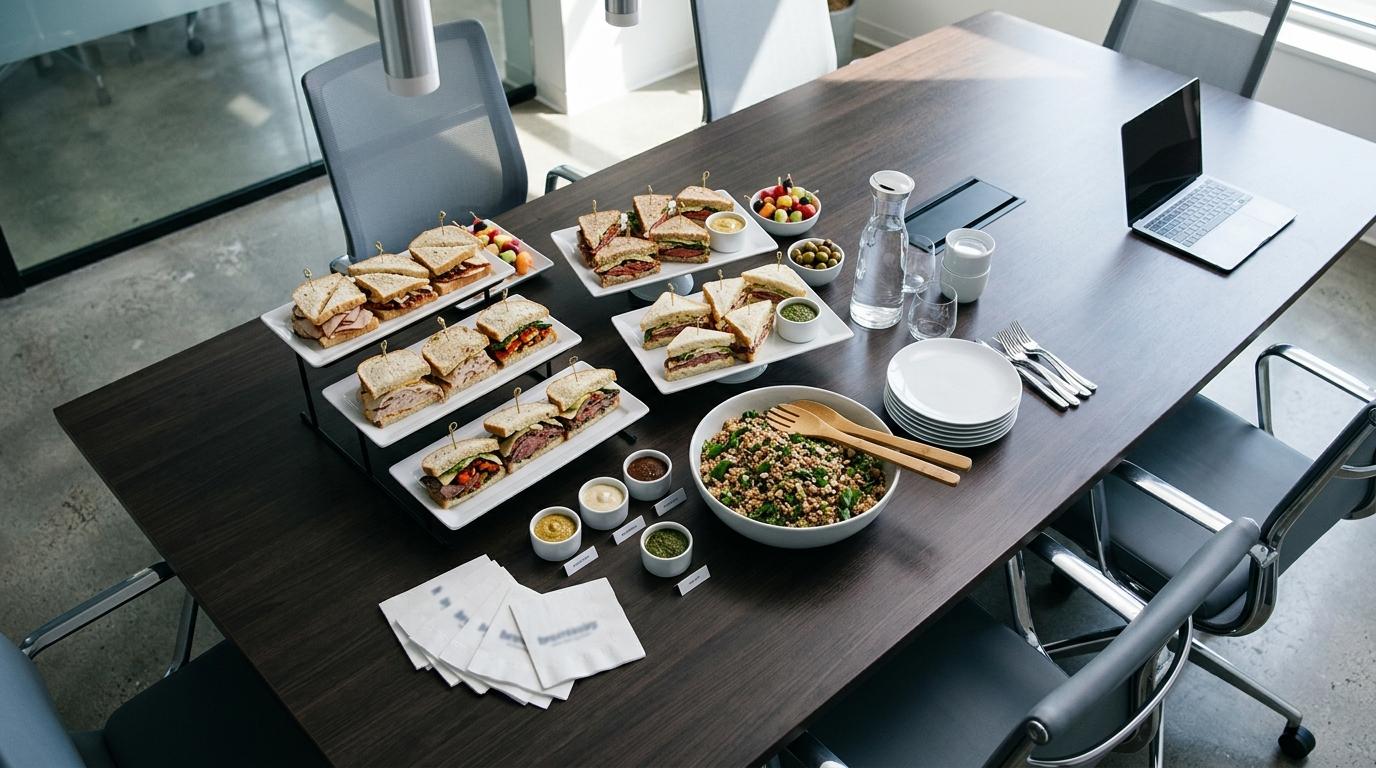
| Deli-style platters | Casual team lunches, training days | Moderate, requires clear labeling | 10–15 minutes | Moderate |
| Café-style buffet | All-hands events, milestone lunches | High variety possible | 20–30 minutes | Higher, needs breakdown plan |
| Breakfast catering spread | Morning presentations, early meetings | Good if gluten-free and vegan added | 10–15 minutes | Low to moderate |
For client meetings specifically, individual boxed meals are underrated. They signal organization and respect for people's time. A labeled box at each seat means no one is hovering over a platter deciding what they can eat while the presentation starts. Deli catering services in Philadelphia are well-positioned for this format because portion control and labeling are standard practice.
Dietary accommodations are not optional in 2026. Plan for a minimum of 20% of your headcount needing at least one of: vegetarian, vegan, gluten-free, or nut-free options. Ask your caterer to label every item, not just the special ones. Guests shouldn't have to ask which sandwich is safe for them.
How to Evaluate Philadelphia Corporate Caterers
There are dozens of catering companies operating in Philadelphia, ranging from full-service event caterers to café operators who handle business accounts as a separate line of business. Picking the right one for corporate work means asking specific questions rather than relying on general reviews.
The five things that separate capable corporate caterers from the rest:
- Minimum order policies and flexibility. Some caterers require 48–72 hours notice. Others can accommodate same-day orders for standing accounts. Know what you need before you commit to a vendor relationship.
- Dedicated corporate account management. For recurring business lunch catering, you want a single point of contact who knows your building, your team's preferences, and your billing setup. This saves significant time over re-explaining every order.
- Documented allergen handling. Ask how cross-contamination is managed in their kitchen and during packaging. A vague answer is a red flag.
- Delivery confirmation process. Professional caterers send confirmation of delivery with a photo or a direct contact call. You should not have to chase down whether your order arrived.
- Scalability. A caterer who handles 20-person team lunches well may not have the staffing for a 200-person company event. Ask about their largest recent Philadelphia corporate delivery to calibrate.
Reading Google and Yelp reviews specifically for the words "on time," "setup," and "office" rather than general food quality gives you a better picture of how a caterer performs in a business context versus a social event.
Building a Recurring Office Catering Program
If your Center City office does lunch meetings more than twice a month, setting up a recurring program with one caterer is more cost-effective and reliable than ordering ad hoc each time. Here is how to structure it.
Start with a trial period of 4–6 orders across different menu formats. Rotate between deli catering, breakfast catering, and platter formats so you can evaluate the caterer's range before committing to a contract. Track three things: arrival time relative to your requested delivery window, food temperature on arrival, and how dietary accommodations were handled.
After the trial, negotiate a standing account. Most Philadelphia business catering companies offer volume pricing for recurring clients, typically a 5–15% discount depending on frequency. More valuable than the discount is priority scheduling: standing accounts usually get delivery windows that one-off orders can't access during busy midweek slots.
Assign one person internally to manage the catering relationship. Rotating who places orders creates inconsistency in what the caterer knows about your preferences, your building access contact, and your headcount patterns. One internal point of contact paired with one account manager at the catering company makes the whole system run cleanly.
What to Budget for Business Lunch Catering in Philadelphia
Per-person costs for office catering in Philadelphia vary significantly based on format and service level. As a working benchmark for 2026: individual boxed lunches from quality Philadelphia deli catering operations typically run in the $18–$30 per person range, depending on protein choices and whether beverages are included. Café-style buffet setups with hot food run higher, often $28–$45 per person, partly because of the setup labor involved.
Breakfast catering is generally the most budget-friendly option for business meetings, often landing in the $12–$22 per person range for a full spread. If your meeting can start at 9:00 AM instead of noon, breakfast catering is a straightforward way to maintain quality while managing costs.
Always confirm whether delivery fees, setup fees, and gratuity are included in the quoted per-person price. In Center City, some caterers add a building surcharge for high-rises with complex logistics. Get the all-in number before you approve the order.
Business Lunch Catering Center City Philadelphia FAQ
How far in advance should I order catering for a business meeting in Center City?
For a standard working lunch, 24–48 hours is the minimum for most Philadelphia corporate caterers. For events over 50 people or orders requiring custom dietary accommodations, 72 hours is a safer target. Standing account clients often get same-day ordering privileges for orders under a set headcount, typically 20–25 people.
What is the best catering format for a formal client presentation?
Individual labeled boxed meals are the strongest choice for formal client meetings. They eliminate the disruption of a buffet line, make dietary accommodations visible and respectful, and signal that the host planned carefully. Pair boxed meals with a beverage station set up before guests arrive to keep the room running smoothly.
Do Philadelphia catering companies handle setup and breakdown?
Many do, but setup and breakdown are often quoted as a separate service from drop-off delivery. Confirm this explicitly when ordering. Full-service setup typically includes arranging food, setting out utensils and napkins, and returning later for breakdown. Drop-off delivery means your team manages everything after the food arrives.
How do I handle dietary restrictions for a large office lunch?
Collect dietary needs at least 48 hours before the event using a simple form sent to attendees. Share the full list with your caterer, not just headcounts. Require labeled packaging on every item. For groups over 30, ask your caterer to separate allergen-sensitive items physically in the delivery so there is no ambiguity during setup.
Is breakfast catering a good option for business meetings in Philadelphia?
Yes, and it is often underused. Breakfast catering works well for morning presentations, training sessions, and client onboarding meetings. It is generally less expensive than lunch catering, faster to set up, and leaves the afternoon schedule clear. A solid breakfast spread with hot coffee, pastries, fruit, and protein options covers most dietary bases without the complexity of a full lunch menu.