
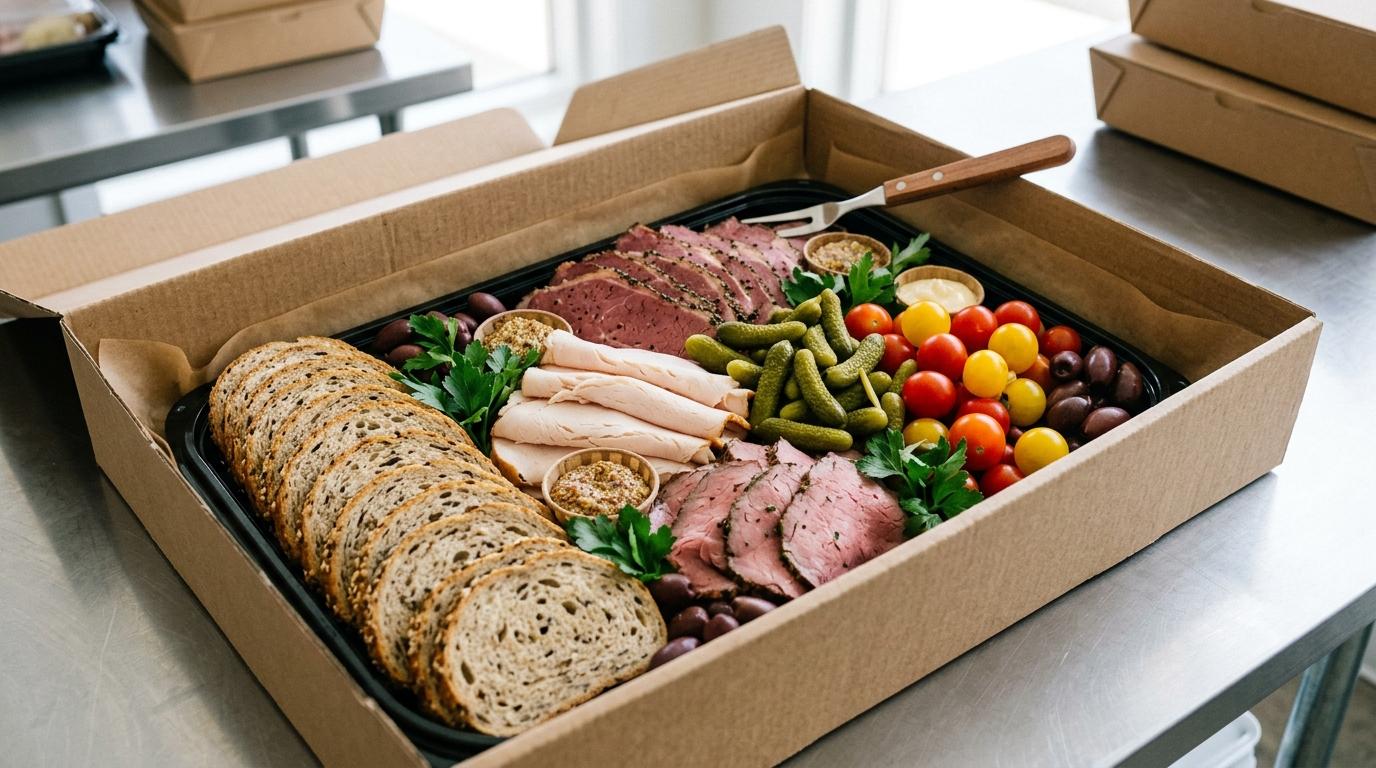
What Makes a Great Deli Platter? The Short Answer
A great deli platter balances protein variety, condiment accessibility, bread-to-filling ratio, and visual presentation so that every guest finds something they want without the host running out of any single item. For Philadelphia business catering, that formula also has to survive a 45-minute transit window and feed a crowd efficiently without requiring utensils beyond a serving fork or spoon.
Whether you are ordering deli catering services in Philadelphia for a lunch meeting in Center City or putting together a breakfast spread for 80 people before a conference, the platter is the workhorse of the menu. Getting it right means knowing what actually goes into the build, not just trusting that more food equals better food.
Start With the Protein Foundation
Protein is the most expensive line item on a deli platter and the element guests remember most. A platter that skimps here feels thin no matter how good everything else looks. The practical benchmark for a standard lunch platter serving 10–12 people is 1.5 to 2 pounds of sliced meat total, spread across at least three proteins.
Why three proteins minimum? Dietary variety. A 12-person office has a reasonable chance of including someone who avoids pork, someone who avoids red meat, and someone who wants a lighter option. Offering turkey breast, roast beef, and tuna or egg salad covers those three without overcomplicating the spread. Adding a fourth option like capicola or pastrami gives the platter character and signals that real care went into the order.
Slice thickness matters more than most people realize. Shaved meat reads as plentiful and layers easily on a roll. Thick-cut slices look premium but stack poorly and are harder to portion. For platters meant for self-service, shaved or thinly sliced proteins let guests build their own portions without wrestling with the food in front of colleagues.
Portion the proteins in separate clusters rather than mixing them on the tray. Guests should be able to identify what they are picking up at a glance. Label anything that is not visually obvious, particularly seafood-based salads and anything with nuts or common allergens.
Cheese: The Ratio That Actually Works
A common mistake in deli platter builds is treating cheese as a garnish. It should account for roughly 30–40% of the total protein-and-cheese weight. For a 10-person platter carrying 1.5 pounds of meat, plan for 8–12 ounces of sliced cheese across two to three varieties.
The winning combination for most Philadelphia business catering contexts is one sharp option, one mild option, and one Swiss-style. Sharp provolone or aged cheddar appeals to guests who want flavor contrast. American or muenster serves those who want something straightforward. Swiss or baby Swiss pairs with nearly every deli meat on the platter. If the group skews toward adventurous palates, swapping American for pepper jack or havarti adds interest without alienating anyone.
Pre-sliced and fanned cheese holds its shape and presentation longer than cheese that has been cut on-site and left in a pile. When you are ordering for a business meeting where the food needs to look good for 90 minutes, fanned or shingled presentation is worth requesting explicitly from your caterer.
Bread and Roll Selection
Bread is the structural element of the platter, and the wrong choice undermines everything else. Soft sub rolls and mini Kaiser rolls are the workhorse options for good reason: they hold together under the weight of fillings, they are easy to split without a knife, and they do not overpower the proteins.
Sourdough or rye slices are a welcome addition for guests who prefer open-faced sandwiches or want a sturdier base. Flatbreads or wraps extend the platter for guests avoiding gluten-heavy bread without requiring a fully separate order, though a true gluten-free option should be sourced separately and kept clearly isolated to avoid cross-contact.
The ratio to aim for is 1.5 rolls or bread portions per person. A 10-person platter should include 15 rolls or equivalent slices. This accounts for guests who go back for seconds on bread even when they do not take more meat, which is a consistent pattern at catered office events. Running out of bread before protein is the fastest way to create a disappointing experience.
Condiments, Spreads, and Accompaniments
Condiments are where platters succeed or fail in the details. The minimum set for any deli spread is: yellow mustard, deli or spicy brown mustard, mayonnaise, and a creamy option like horseradish sauce or aioli. Yellow mustard alone reads as an afterthought. Offering both a mild and a bold mustard gives guests a meaningful choice without cluttering the table.
Accompaniments do two things. First, they add visual mass to the platter at a lower cost than protein. Second, they give guests something to do while the line moves. Standard accompaniments that earn their place on a platter include:
- Sliced tomatoes and red onion, kept separate so guests who want them can add them without others having to pick them off
- Whole leaf lettuce or shredded romaine, which stays crisper than pre-layered greens
- Pickle spears or sliced pickles in a ramekin rather than scattered across the tray
- Pepperoncini or banana peppers for guests who want acidity and heat
- Sliced avocado or a small portion of guacamole if the platter is going to be consumed within 30 minutes of opening
Keep wet condiments and accompaniments in small dishes or ramekins at the edge of the platter rather than pre-applied to anything. This is the single most important rule for preserving bread texture over a 60-minute service window.
Presentation and Transit: What Caterers Get Right and Wrong
A platter that looks great in the kitchen needs to survive the ride to your office in Center City. Professional Philadelphia catering companies build platters with transit in mind: proteins covered with plastic wrap, bread packed separately and added on-site, and condiments sealed in individual containers. If your caterer delivers everything pre-assembled and soaking together, that is a signal about their operational standards.
For presentation on arrival, the rule is height and color. Fold deli meats into rosettes or fan them rather than laying them flat. Alternate light and dark proteins so the tray reads as varied at a glance. Cheese fans placed at the border of the tray frame the proteins and fill visual gaps without adding complexity. Garnish with a handful of cherry tomatoes or fresh parsley around the edges. The goal is a tray that looks abundant without looking chaotic.
For breakfast catering versions of the deli platter concept, the protein shifts to smoked salmon, egg salad, and cream cheese spreads alongside bagels, mini croissants, and whole-grain toast. The same structural rules apply: separate wet components, label proteins, plan 1.5 bread portions per person, and keep condiments in ramekins rather than pre-applied.
How to Scale for Larger Groups
Scaling a deli platter for groups larger than 20 is not simply a matter of doubling everything. Larger groups need more variety in proteins, not just more of the same three. A 40-person order benefits from five or six proteins because the range of dietary preferences widens significantly. It also benefits from having platters broken into smaller trays of 15–20 portions each rather than one enormous tray, which is harder to manage, harder to replenish, and presents worse as it is picked over.
For catering for businesses in Center City Philadelphia, the practical rule is one tray per 15–20 guests, with a dedicated vegetarian or protein-free tray if the headcount is above 30. This prevents the vegetarian options from disappearing in the first five minutes while omnivores graze past them.
Budget-wise, quality deli platters for business catering in Philadelphia generally run higher per head for smaller groups because of setup and delivery minimums. Larger orders bring the per-head cost down meaningfully, which is worth factoring in when deciding whether to add a few extra guests to a meeting invite.
Deli Platter FAQ for Philadelphia Business Catering
How far in advance should I order a deli platter for a business meeting?
Order at least 48 hours in advance for groups under 20 people. For groups of 20 or more, 72 hours is the safer standard with most Philadelphia catering companies, especially for Friday or Monday delivery when demand peaks.
How long does a deli platter stay fresh at room temperature?
Sliced deli meats and cheeses are food-safe at room temperature for up to 2 hours. After that point, they should be refrigerated or discarded. For a 90-minute meeting, a platter set out at the start of the event is fine. For all-day grazing, plan to refresh the platter mid-day or work with your caterer to provide replenishment.
What is the right portion size per person for a deli platter?
Plan for 3–4 ounces of protein per person and 1–1.5 ounces of cheese per person as a lunch portion. For a lighter working lunch where other food is also on the table, 2–3 ounces of protein per person is sufficient. For breakfast deli spreads, reduce protein portions by about 25% and increase bread portions accordingly.
Should I order separate platters for dietary restrictions or try to build one inclusive tray?
A single inclusive tray works well for groups under 15. For larger groups, ordering a dedicated vegetarian tray and keeping it clearly labeled prevents dietary-restricted guests from competing with the general population for limited options. Cross-contamination concerns for guests with allergies also argue for a physically separate tray rather than relying on guests to self-select around allergens on a shared platter.
What is the difference between a deli platter and a sandwich tray?
A deli platter provides proteins, cheeses, breads, and condiments as separate components so guests build their own. A sandwich tray delivers pre-made sandwiches cut and arranged for immediate eating. Platters work better for longer events, larger groups, and situations where guests have strong individual preferences. Sandwich trays are faster for high-volume service where speed matters more than customization.