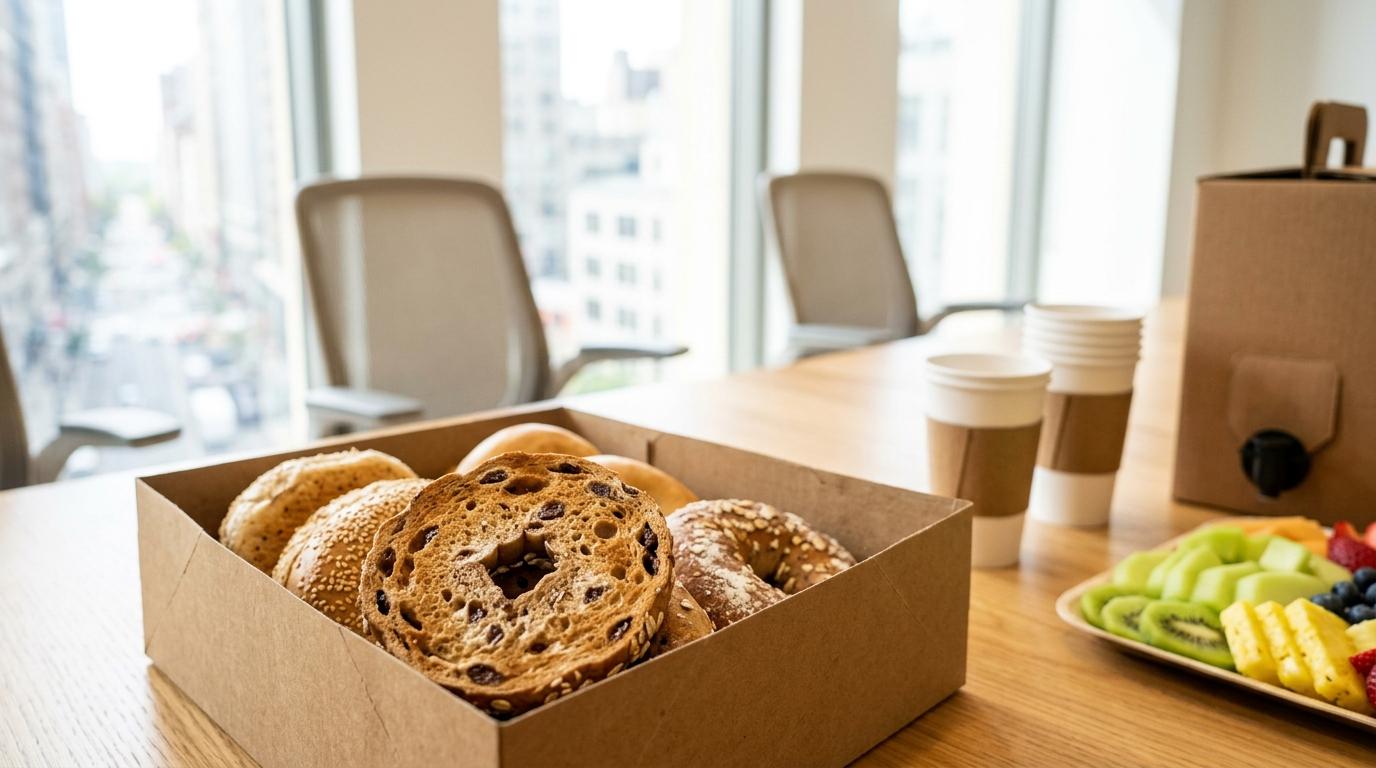
Your office needs breakfast catering if you hold regular meetings before 10 a.m., host early client sessions, or notice staff skipping the first hour of the day to hunt for food. For most Philadelphia teams of 10 or more, a standing morning order of bagels, coffee, and fruit costs roughly $10–$18 per person and pays back in attendance, punctuality, and goodwill. Here are five signs it's time to order, plus how to do it without waste.
Sign 1: Your Morning Meetings Start Late or Thin
If your 8:30 a.m. staff meeting regularly starts at 8:45 because people are still grabbing coffee on Walnut Street or waiting in line at a Center City cafe, food is a scheduling problem you can solve. Catering removes the detour. Attendance becomes easier to hold when the coffee is already in the room.
Concrete guidance for this scenario:
- Order delivery 30 minutes before the meeting. That gives you time to set up and keeps bagels from sitting out for an hour.
- Plan 1.25 bagels per person for a mixed group, or one bagel plus a pastry or fruit cup.
- Plan 12 ounces of coffee per person, roughly one 96-ounce box for every 8 people.
The trade-off: if the meeting is only 15 minutes and everyone eats at home, a full spread is overkill. Coffee and a small pastry tray is enough in that case.
Sign 2: You Host Early Client or Candidate Sessions
When a client arrives at 8 a.m., the first impression is the room, and the food is part of the room. Showing up with a conference table that has nothing on it reads as unprepared, and sending an assistant to a cafe for a dozen coffees reads as improvised. Corporate breakfast catering in Philadelphia solves both with a single order.
For client-facing mornings, prioritize:
- Clean, individually portioned items. Wrapped breakfast sandwiches, yogurt parfaits, and pre-sliced fruit avoid the awkwardness of eating in front of guests.
- Dietary coverage. Ask for at least one vegetarian, one gluten-free, and one dairy-free option, labeled.
- Real tableware. Request plates, napkins, utensils, and cups in the order so nothing is missing.
Interviews work the same way. Candidates who are offered coffee and a bagel before a 9 a.m. panel are calmer, and your interviewers stay on schedule instead of scrambling for supplies.
Sign 3: Your Team Is Hybrid and Mornings Are Your In-Person Anchor
Many Philadelphia offices now run two or three in-office days. If you hold a team meeting on those days, breakfast is one of the cheapest incentives to make the commute feel worthwhile. Employees weigh the trip into Center City against the cost of transit, parking, and their own breakfast. A free spread tips that math.
Make it recurring, not random. A weekly or biweekly standing order, for example every Tuesday and Thursday delivery, does three things:
- Sets a predictable rhythm people plan around.
- Lets you negotiate a standing rate or simplified ordering with your caterer.
- Gives you real headcount data so you stop over-ordering.
Track RSVPs for the first month. If you order for 20 and 14 show up, adjust to 15 plus a small buffer. Most offices land on ordering for 85–90% of the in-office headcount.
Sign 4: You Are Spending More on Ad Hoc Food Runs Than a Standing Order Would Cost
Add up what actually happens now: an office manager spends 25 minutes on a coffee run, someone expenses a $60 cafe order, another picks up two dozen bagels on a personal card. Those small purchases hide labor cost and reimbursement paperwork.
Here is how the common options compare:
| Option | Typical cost per person | Staff time | Best for |
|---|---|---|---|
| Bagel and coffee catering | $8–$12 | Minimal, one order | Standing meetings, large groups |
| Hot breakfast sandwich catering | $12–$18 | Minimal, one order | Client sessions, all-hands |
| Cafe pickup run | $9–$14 | 20–40 minutes | Small, one-off needs |
| DIY grocery or bakery run | $5–$9 | 45+ minutes | Tight budgets, tiny teams |
Prices vary by caterer and menu, so request a written quote. The point is the staff-time column: a $6 per person savings disappears when a salaried employee burns an hour on logistics. If you run more than two food runs a month, a delivery account is usually cheaper in real terms.
Sign 5: People Are Skipping Meals or Leaving to Find Them
Watch the first hour of an early workshop or training. If attention drops by 9:30, or people drift out to find food, you are losing productive time. Long morning sessions such as quarterly planning, onboarding, and trainings are where breakfast catering earns the most.
For sessions longer than two hours, build a two-stage setup:
- Arrival spread: bagels, spreads, fruit, and coffee, set out 15–30 minutes before start.
- Mid-session refresh: fresh coffee and tea, and optionally a light snack, around the 90-minute mark.
Also confirm the logistics that trip people up: building security and loading dock rules, elevator access in Center City high-rises, and who meets the driver in the lobby. Give the caterer a named contact and a cell number. Most failed deliveries come from the driver being unable to get upstairs, not from the food.
How to Order Without Waste or Surprises
Once you decide to order, a few habits keep the experience smooth:
- Order 48–72 hours ahead for groups under 30, and a week ahead for 50 or more. Same-day orders are possible with some caterers but limit your menu.
- Ask about delivery windows and fees. Center City delivery is often a flat fee or free above a minimum, but minimums commonly sit around $75–$150.
- Request labeled dietary items and a separate allergen note on the invoice.
- Choose packaging that matches the room. Boxed individual meals suit tight conference rooms. Platters suit open kitchens.
- Plan leftovers. Send extras to a common area within an hour for food safety, and keep hot items out of the temperature danger zone (above 140°F or below 40°F).
When You Probably Do Not Need It
Breakfast catering is not for every office. Skip it if your team is under six people, your meetings run after 10 a.m., or your culture already has a reliable cafe next door that people use together. In those cases, a quarterly breakfast for special occasions is a better spend than a standing order.
Office Breakfast Catering FAQ
How much does office breakfast catering cost in Philadelphia?
Expect about $8–$12 per person for bagels, spreads, and coffee, and $12–$18 per person for hot breakfast sandwiches or a fuller spread. Delivery fees and minimums, often $75–$150, apply on top.
How far ahead should I order morning meeting catering?
Order 48–72 hours ahead for groups under 30 and about one week ahead for 50 or more guests. Recurring orders can be locked in monthly so you never think about it again.
How much food do I need per person?
Plan 1.25 bagels or one breakfast sandwich per person, plus one side such as fruit or yogurt, and about 12 ounces of coffee. Order for roughly 85–90% of headcount if attendance varies.
Can breakfast catering handle dietary restrictions?
Yes. Ask for labeled vegetarian, vegan, gluten-free, and dairy-free items at the time of ordering, and list any allergies on the order so the kitchen can note them on the invoice.
Is a standing weekly breakfast order worth it?
For teams of 10 or more with regular in-office meetings, yes. A standing order cuts staff time spent on food runs, gives you predictable costs, and improves attendance on in-person days.