For most Philadelphia meetings and events, continental breakfast catering is the better fit when you have under 90 minutes, a standing or mingling crowd, or a budget near $12–$18 per person. Hot breakfast catering earns its higher cost (roughly $18–$30 per person) when guests sit for a long program, travel in early, or you are hosting clients you need to impress. Here is how to decide, and how to plan either one well in Center City and beyond.
Continental vs. Hot Breakfast: The Quick Comparison
| Factor | Continental Breakfast | Hot Breakfast |
|---|---|---|
| Typical menu | Pastries, bagels, fruit, yogurt parfaits, coffee, juice | Scrambled eggs, bacon or sausage, potatoes, breakfast sandwiches, plus continental items |
| Estimated cost per person | $12–$18 | $18–$30 |
| Setup needs | Table space only | Chafing dishes, fuel, serving utensils, more table space |
| Best event length | Under 90 minutes | 2 hours or longer |
| Best format | Networking, standing receptions, quick client meetings | Seated seminars, all-morning conferences, executive briefings |
| Mess and cleanup | Low | Moderate |
| Dietary flexibility | Easy to label and cover vegan, dairy-free, gluten-free | Requires separate dishes or clearly separated trays |
Prices vary by caterer, headcount, and delivery location, so treat these as planning ranges and confirm with a written quote.
When Continental Breakfast Catering Is the Right Call
A continental spread works because it is fast. Guests grab a bagel and coffee, then get to their seats. That matters in Philadelphia, where attendees often arrive straight from Regional Rail, the Broad Street Line, or a parking garage on Market Street and want to start on time.
Choose continental when:
- The meeting starts at 8:00 or 8:30 a.m. and runs under 90 minutes. People eat lightly and move on.
- Your room has limited space. Many Center City conference rooms and shared office floors have a single credenza or small counter. Continental items fit on a 6-foot table.
- The building restricts open flame or fuel. Some office towers and historic buildings restrict chafing fuel. Ask your property manager before ordering hot food.
- You are feeding a mixed-diet group. Fruit, yogurt, oatmeal, and bagels with spreads cover vegetarian, vegan, and dairy-free guests without extra planning.
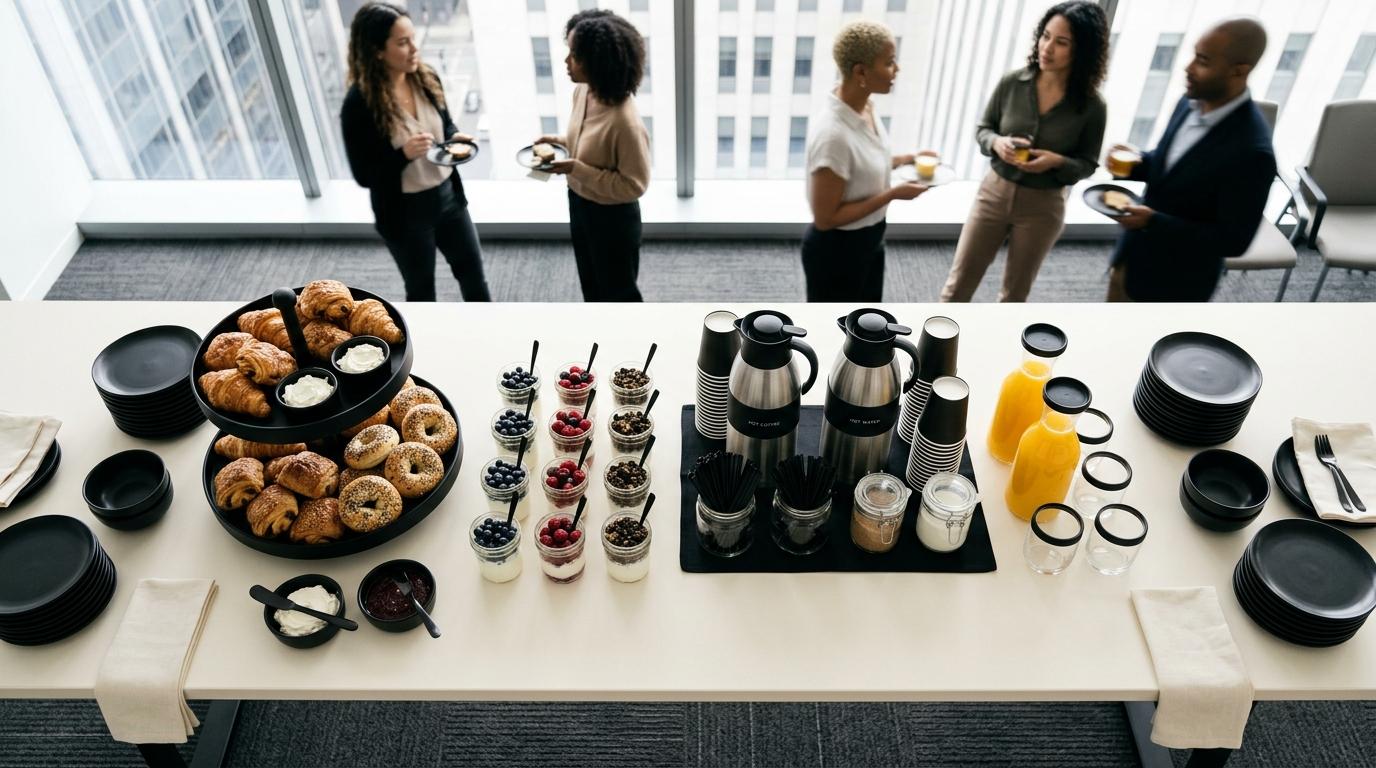
To make continental feel intentional rather than basic, ask for a mix of 3 or 4 pastry types, whole fruit and cut fruit, individual yogurt parfaits, and a bagel platter with cream cheese, butter, and a plant-based spread. Add hard-boiled eggs or egg bites for protein if you are skipping a full hot menu.
When Hot Breakfast Catering Is Worth the Upgrade
Hot breakfast pays off when food is part of the experience, not just a courtesy. If guests are sitting through a half-day seminar, a continental spread leaves many of them hungry by 10:30 a.m. and the afternoon energy dip arrives sooner.
Choose hot breakfast when:
- The event runs 2 hours or more or is a full-day conference where breakfast is the main morning meal.
- You are hosting clients, board members, or prospects. A warm spread signals care and gives people a reason to linger and talk before the agenda starts.
- The event is a private early-morning gathering, such as a retirement breakfast, a retreat, or a wedding-day getting-ready brunch.
- Guests travel in from outside the city. People who left home at 6 a.m. want a real meal.
Breakfast sandwiches are the most practical hot option for business settings. They are handheld, individually wrapped, and keep their temperature for 30 to 45 minutes in an insulated carrier, so they work even when a room has no space for chafing dishes. Egg-and-cheese sandwiches on a bagel, croissant, or roll are the Philadelphia classic and rarely go uneaten.
The Hybrid Option Most Planners Overlook
You do not have to pick one side. A hybrid menu gives you continental as the base and adds one or two hot items, which typically lands around $15–$22 per person.
Three combinations that work well:
- Continental plus breakfast sandwiches. Order sandwiches for about 60 percent of the headcount and let the pastries and fruit cover the rest.
- Continental plus a hot oatmeal or egg bite bar. Both hold well and suit health-focused crowds.
- Continental plus one hot protein. A tray of sausage or bacon turns a light spread into a satisfying one.
Hybrid ordering also reduces waste. Hot items are the most likely to be left over, so ordering fewer of them than your headcount limits spoilage while still giving guests something warm.
Planning Around Philadelphia Logistics
The menu is only half the decision. Delivery and timing in the city can matter just as much.
- Build in a 30-minute delivery buffer. Traffic on I-676, Market Street, and around Rittenhouse and City Hall is unpredictable between 7 and 9 a.m. Ask for arrival at least 30 minutes before guests, and 45 for a hot setup.
- Confirm loading dock and elevator access. Many Center City buildings require a certificate of insurance, a reserved freight elevator, or a specific delivery window. Send your caterer the building rules a week ahead.
- Plan for coffee separately. Count on about 1 cup per person for a short meeting and 1.5 cups for a long one. A 96-ounce coffee box serves roughly 10 people. Add hot water and tea for anyone who skips coffee.
- Decide on disposables or full service. Compostable plates and cutlery are standard for drop-off orders. Full-service setup with staff and china is worth it for client-facing events or groups over 50.
- Check for early-morning event timing. For 7:00 a.m. starts, you will need delivery by 6:15 a.m. Confirm that your caterer offers that window, since not every business does.
How Much Food to Order
Over-ordering is the most common mistake. Use these guidelines for a group where breakfast is the only food served:
- Pastries and bagels: 1.5 pieces per person, with a mix of mini and full-size items.
- Fruit: 4 to 5 ounces per person.
- Yogurt or parfaits: enough for about 40 percent of guests.
- Hot entrees (eggs, potatoes, meat): 6 to 8 ounces total per person.
- Breakfast sandwiches: 1 per person if it is the main item, 0.6 per person in a hybrid spread.
For dietary needs, plan on roughly 10 to 15 percent of guests needing a vegetarian, vegan, gluten-free, or allergy-conscious option. Collect restrictions with your RSVP and ask for individually labeled items so nobody has to ask a staff member in front of colleagues.
Which Should You Choose? A Simple Decision Guide
- Quick client meeting of 10 people or fewer: continental, or a small hybrid with sandwiches.
- Networking breakfast with standing guests: continental with a few handheld hot items.
- Half-day seminar or training: hot breakfast or a hybrid.
- Full-day conference: hot breakfast, with a continental refresh at mid-morning.
- Private early-morning celebration: hot breakfast with a few signature items.
If you are still unsure, ask your caterer for a tasting or a sample tray. Most Philadelphia catering businesses can customize a menu to the headcount and venue, and telling them your start time, event length, and room setup will get you a better quote than asking for a package by name.
Breakfast Catering FAQ
How far in advance should I order breakfast catering in Philadelphia?
Order at least 48 hours ahead for groups under 25 and one to two weeks ahead for groups over 50. Spring and fall conference seasons book up quickly, so reserve earlier for those months.
What is the difference between continental and hot breakfast catering?
Continental breakfast is a cold or room-temperature spread of pastries, bagels, fruit, yogurt, coffee, and juice. Hot breakfast adds cooked items such as eggs, bacon, sausage, potatoes, or breakfast sandwiches, and it needs warming equipment or insulated packaging.
How much does breakfast catering cost per person in Philadelphia?
Continental breakfast typically runs $12–$18 per person, hybrid menus $15–$22, and full hot breakfast $18–$30. Delivery fees, service staff, and rentals are usually extra.
Can breakfast catering be delivered to my office in Center City?
Yes. Most local caterers deliver to Center City offices and will set up in conference rooms. Share your building's delivery rules, elevator requirements, and insurance needs when you place the order.
How do I handle dietary restrictions at a breakfast event?
Collect restrictions with your RSVP, plan for 10 to 15 percent of guests needing a special option, and ask your caterer to label every item with its main allergens. Fruit, oatmeal, and plant-based spreads cover many needs on a continental menu.